
Wooden Fence Cost: A Homeowner's Pricing Guide

A professionally installed wooden fence typically runs about $10–$45 per linear foot, so a typical 150-foot residential project lands in the $3,000–$7,500 range before gates, removal, or finishes. If you're standing in a St. Charles or O'Fallon backyard right now, looking at a leaning fence, a dog that needs containment, or neighbors who can see straight onto your patio, that range can feel uselessly wide. You don't need a national average. You need to know which end of that range your yard belongs on, and why.
That's what a good quote tells you. A bad quote gives you one number and no way to tell whether posts, gates, tear-out, or stain are in it or waiting as a surprise later. This guide treats wooden fence cost as contractors build it, line by line, and as homeowners pay it, over the life of the fence, not just on install day.
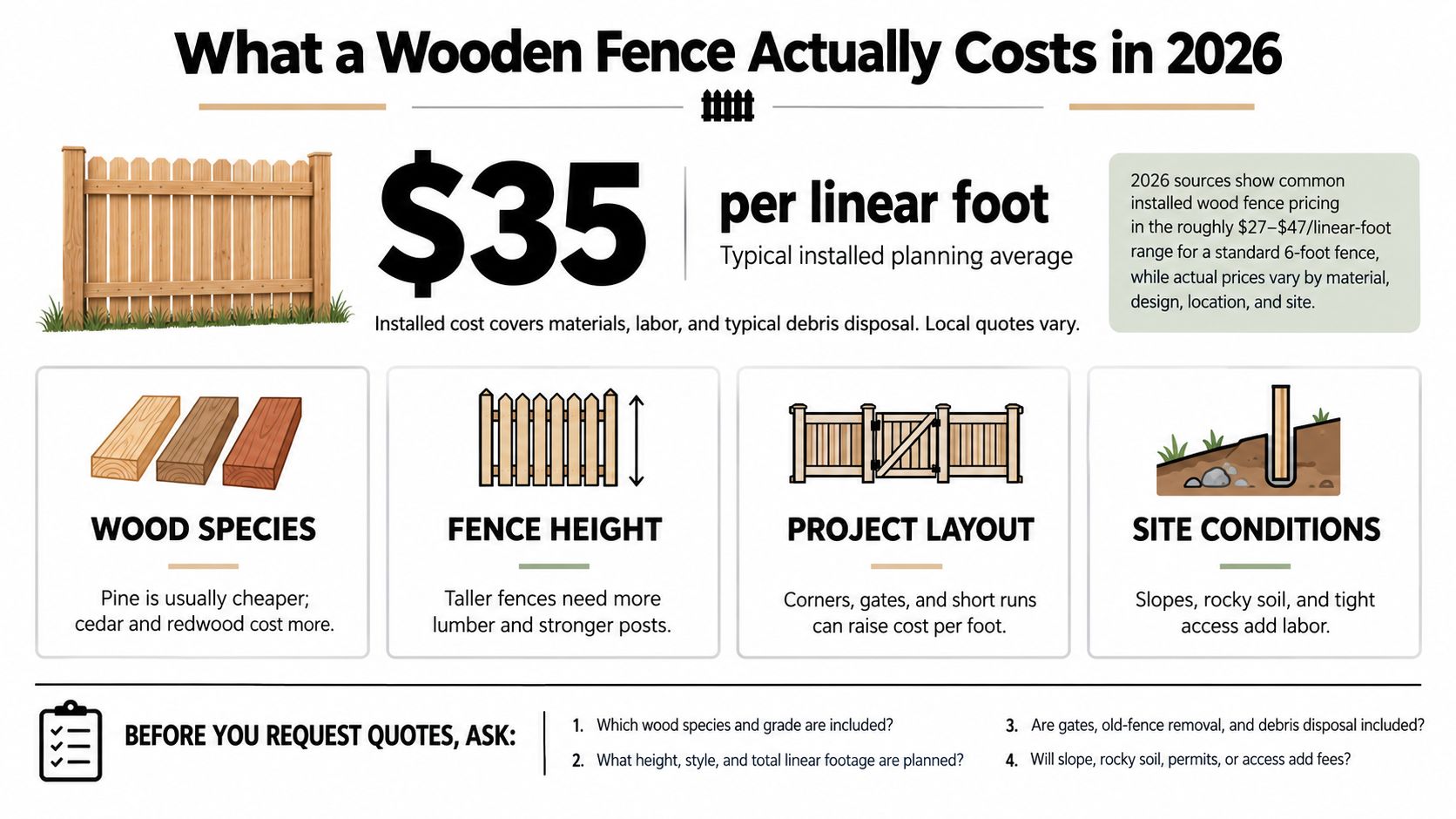
What a Wooden Fence Actually Costs in 2026
Start with the anchor, then adjust for your property. In the United States, professionally installed wood fence pricing commonly runs about $10–$45 per linear foot, driven by wood species, fence height, design, terrain, access, and local labor rates. A national average installation sits around $3,235, with a typical total range of $1,920–$4,840, but those figures blend tiny garden enclosures with full backyard privacy jobs and shouldn't be used to judge your bid.
Use dimensions instead. A quarter-acre lot fenced along two sides runs approximately $2,100–$9,400 for wood, which tells you the story. Linear footage multiplies everything, lumber, posts, concrete, fasteners, and hours. Regional labor matters too, and the same fence prices differently in Illinois than it does in California or New York. In the St. Louis suburbs, you're paying Midwestern labor rates, but you're also digging in clay, dealing with frost depth, and meeting neighborhood rules that often dictate height and finished side orientation.
What Installed Cost Should Include
Materials-only pricing is the number on a lumberyard tag. Installed cost is what you pay to get a straight, plumb, finished fence standing in your yard. Those are different numbers, and confusing them is how homeowners end up thinking a fair contractor is padding a bid.
An installed price should cover posts, rails, pickets, concrete, hardware, layout, digging, setting, alignment, and cleanup. Whether it covers removal of the old fence, haul-off, gates, permits, grading, or staining depends on the written scope. Too many homeowners compare one bid that includes tear-out and disposal against another that excludes both without noting the difference, then choose the cheaper one and pay the difference later anyway.
Practical rule: Don't compare totals until you've confirmed that both bids describe the same fence, the same removal scope, and the same gates.
Why a 150-Foot Fence Swings So Widely
Take a flat, open backyard in St. Peters with easy truck access, no old fence to remove, and a standard design. That job prices clean. Now take the same footage in Wildwood with a slope, tree roots along the line, tight side-yard access that forces hand digging, and an old fence to tear out and haul. Same length, completely different labor. Add a taller privacy design with more pickets and rails, and material costs climb on top of the labor difference.
That's why one 150-foot job lands near the low end and another pushes well past the middle. Neither contractor is necessarily wrong. They're pricing different work.
Four Questions to Answer Before You Call Anyone
Before you request estimates, nail down these four things, because every contractor will ask them anyway.
How many linear feet: Walk the line with a tape or measuring wheel and note corners, jogs, and where the fence ties into the house or an existing run.
How tall and which style: Decide whether you need full privacy screening, a decorative front-yard boundary, or simple containment, since height and style set material volume.
How many gates and where: Gates need framing, hardware, and adjustment time, and a wide double gate for mower or trailer access is a different build than a single walk gate.
What comes out first: Note whether an existing fence, shrubs, or debris sit on the line, because removal and disposal belong in writing, not in assumptions.
With those answers in hand, you're not asking for a ballpark. You're asking for a price on a defined project, and that's when quotes become comparable.
The Four Drivers Behind Every Fence Quote
Every bid you receive is built from four drivers, whether the contractor explains them or not. Learn them and you can read a quote the way the person who wrote it does. You'll also know which decisions to settle early, because changing them late is what triggers re-pricing.
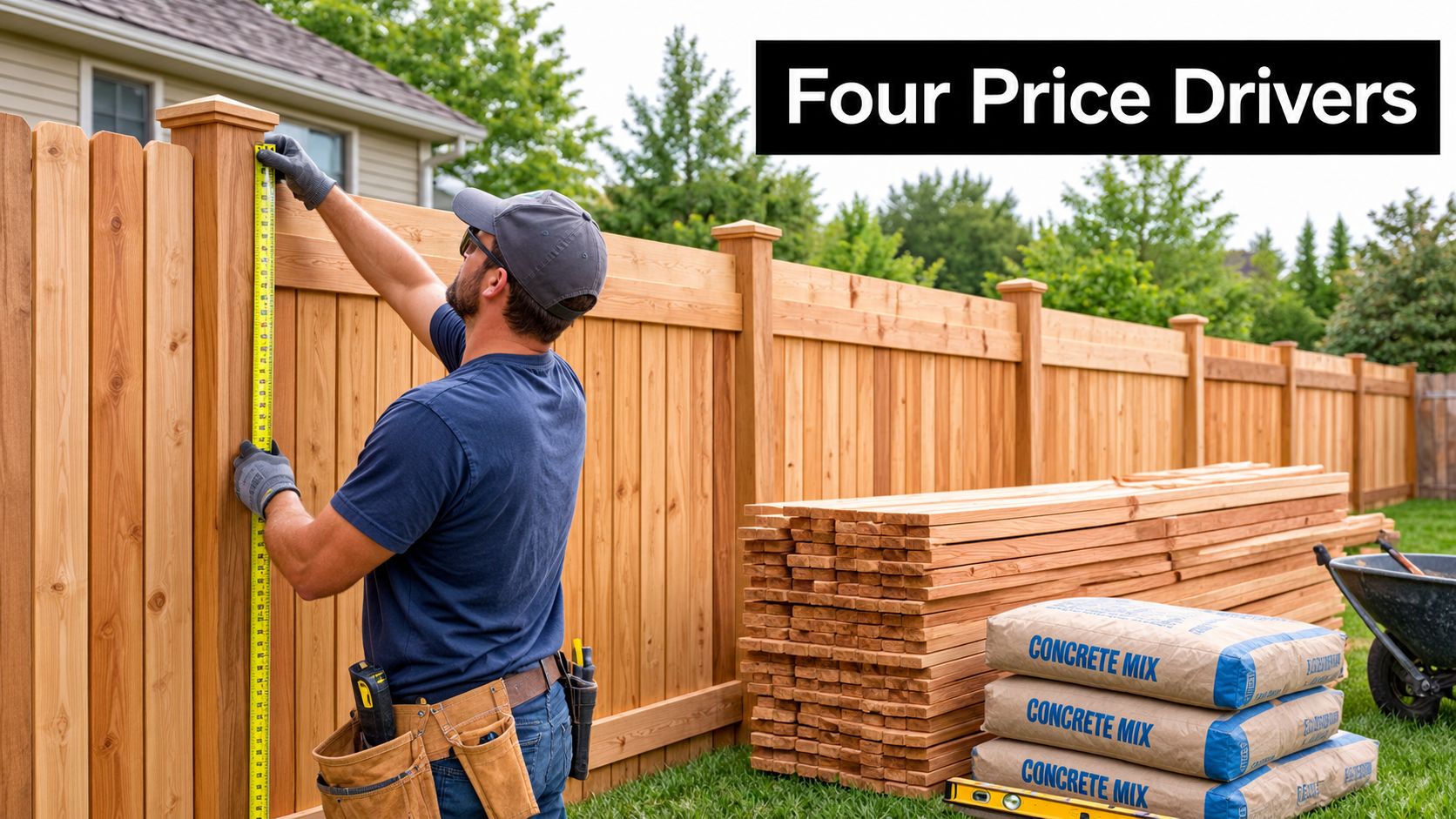
The photo below shows the kind of on-site measuring that should happen before anyone gives you a firm number, because footage and layout drive everything downstream.
Wood Species
Pressure-treated pine sits at the lower-cost end of the market. Cedar and redwood cost more because of appearance, durability characteristics, availability, and regional supply. Species affects more than the picket price, since posts, rails, and gate framing all draw from the same lumber market. That market moves, too. Lumber prices increased by more than 300% between April 2020 and May 2021, basic wood-fencing materials commonly ran around $15–$30 per linear foot in 2020 against pre-pandemic averages closer to $10–$20, installed prices in 2019 ranged roughly $15–$50 per linear foot, and by 2023 prices had risen approximately 20%–30% in many situations.
That history matters for one practical reason. A quote has a shelf life. If a contractor prices your job in March and you approve it in June, don't be shocked if the number gets revisited, and ask up front how long the price holds.
Fence Height
Height is a multiplier, not a cosmetic detail. A 4-foot picket fence uses short boards, lighter framing, and smaller posts, and a crew can move fast. A 6-foot privacy fence uses longer pickets, more rails, longer posts, deeper footings, and more alignment work to keep tall panels straight and consistent. Wind load also rises with height, which is why post depth and spacing matter more on tall fences than short ones.
If your goal is screening a patio, you need the height and should pay for it. If your goal is defining a front-yard boundary, paying for privacy height you don't need is wasted money. Decide based on function, not habit.
Project Layout
Layout covers footage, corners, gates, and transitions. A long straight run down one side of a lot is the cheapest fence per foot you'll ever buy, because the crew sets a rhythm and repeats it. Every corner adds a post and layout time. Every gate interrupts the run and adds framing, hinges, a latch, and adjustment. Stepped sections on a slope, angled transitions, and tie-ins to a house, garage, or existing fence all slow the crew down.
This is also where outdoor projects connect. Homeowners planning a fence and a deck in the same season often phase the layout together so gate placement matches deck stairs and traffic flow, which is worth discussing when you review decking options for the same backyard. Moving a gate on paper costs nothing. Moving it after posts are set costs real money.
Site Conditions
Site conditions are where quotes separate. Flat, open, and accessible is cheap. Sloped, wooded, rocky, or tight is not. Clay soil that fights the auger, roots along the property line, buried debris from an old fence, and a side yard too narrow for equipment all add hours. Drainage matters too, because a fence line that holds water will punish posts and bottom rails for years.
A contractor who prices your job without walking the line hasn't priced your site conditions. He's guessed at them, and you'll pay for the correction later.
Walk the line with each bidder. Point out the slope, the wet corner, and the tight gate access. The contractor who asks about those things before you mention them is the one who's dug post holes in Chesterfield and Ballwin clay before.
Cedar, Pine, Picket, Privacy, and Split-Rail Compared
Homeowners shop styles like they're interchangeable. They're not. Each design solves a different problem, uses a different amount of lumber, and disappoints in a different way when it's matched to the wrong yard. Here's how I'd steer you on a typical suburban lot.
Pressure-Treated Pine Versus Cedar
This is the decision most homeowners get wrong by treating it as a price tag comparison. For pressure-treated pine installed at approximately $15–$28 per linear foot and cedar at about $20–$38 per linear foot, pine wins on day one, every time. Properly stained pine can last 20–30 years, and cedar resists rot naturally, but those lifespan claims assume maintenance occurs and posts are specified correctly.
Pine is the right call for budget-driven projects, rentals, and sellers who need a sound, good-looking fence without paying a premium they'll never recover. Its weakness is movement. Pine pickets can warp, cup, and check as they dry, and it depends on stain or sealant for surface protection. If you won't maintain it, pine tells on you fast.
Cedar is the right call when appearance matters and you plan to stay. It machines cleanly, stays straighter, takes stain beautifully, and carries natural decay resistance that pine gets only from chemical treatment. Its weakness is simple. You pay more up front, and on a dry, sunny, well-drained lot where pine would have performed fine, that premium may never pay you back.
My blunt take is this. Spend on cedar pickets if the fence is a visible feature of a yard you'll live with for years. Save with pine if the fence is functional containment, a side-yard run nobody looks at, or a pre-sale fix. Either way, don't cheap out on the posts, because post failure ends fences of every species.
Picket Fences
A picket fence is a front-yard and garden fence. Short height, spaced pickets, curb appeal. It's the right choice for defining a boundary, keeping small dogs in a front yard where codes limit height, and giving a home in Lake St. Louis or Ballwin that finished street-facing look. It doesn't give privacy and was never meant to. Homeowners who install picket in a backyard hoping for screening end up disappointed and planting shrubs to do the job the fence can't.
Material volume is low, so cost per foot stays moderate, but picket work is detail work. Spacing, tops, and alignment show every inconsistency at street distance.
Privacy Fences
The 6-foot privacy fence is the workhorse of St. Louis suburbs for a reason. It screens patios and pools, contains dogs, and turns a backyard into a room. It's also the most material-hungry common design, with tight pickets, multiple rails, tall posts, and real wind load. That combination puts it at the higher end of both material and labor.
Choose privacy where you need screening, along the back and sides of a living space. Don't run it around an entire large lot by default. I've talked homeowners out of fencing acreage in full privacy when a shorter run around the patio plus a cheaper boundary treatment elsewhere would serve them better for far less money.
Split-Rail Fences
Split-rail is a boundary marker, not a barrier. Two or three horizontal rails, widely spaced posts, and mostly open air. It suits large lots, rural edges of Wildwood, and properties where you want a visual property line with a rustic look. It won't contain a small dog without added wire mesh, and it gives zero privacy. Where it shines is cost per foot over long distances, because there's less lumber and labor in every section.
Installed Cost Ranges by Fence Style and Material
The table below uses the installed ranges for pine and cedar noted above, with style guidance matched to how each design gets used. Lifespan assumes ground-contact-rated posts and routine staining or sealing, since neglected wood of any species fails early.
Style | Typical Installed Range | Lifespan | Best For |
|---|---|---|---|
Pressure-treated pine privacy | $15–$28 per linear foot | Up to 20–30 years when properly stained | Backyard screening on a budget, rentals, pre-sale installs |
Cedar privacy | $20–$38 per linear foot | Long service with natural rot resistance and upkeep | Long-term homeowners, visible patio and pool screening |
Picket | Lower material volume than privacy at the same species | Depends heavily on stain upkeep and post quality | Front yards, gardens, curb appeal, boundary definition |
Split-rail | Lowest material volume of the common styles | Rails and posts weather in place, spot repairs are simple | Large lots, acreage, decorative property lines |
Read that table as a matching exercise, not a menu. The cheapest style that solves your actual problem is the right buy. The most expensive mistake is paying privacy-fence money for a boundary-marking job, or picket-fence money and expecting privacy.
How Materials, Labor, and Extras Add Up
A single total on a quote tells you almost nothing. An itemized quote tells you where your money goes, where you can trim without hurting the fence, and where a low bidder cut a corner you'll pay for later. Insist on the breakdown.
For U.S. budgeting, professionally installed wood fencing commonly falls near $20–$50 per linear foot, which implies approximately $4,000–$10,000 for a 200-linear-foot enclosure at that same benchmark and roughly $3,000–$7,500 for 150 feet before unusually expensive gates, demolition, difficult excavation, or premium lumber. Labor alone is often reported at roughly $5–$20 per linear foot, with privacy fencing near the upper end because it uses more pickets, rails, fasteners, and alignment work. A standard gate can add roughly $200–$600, and paint or stain may add about $2–$14 per linear foot.
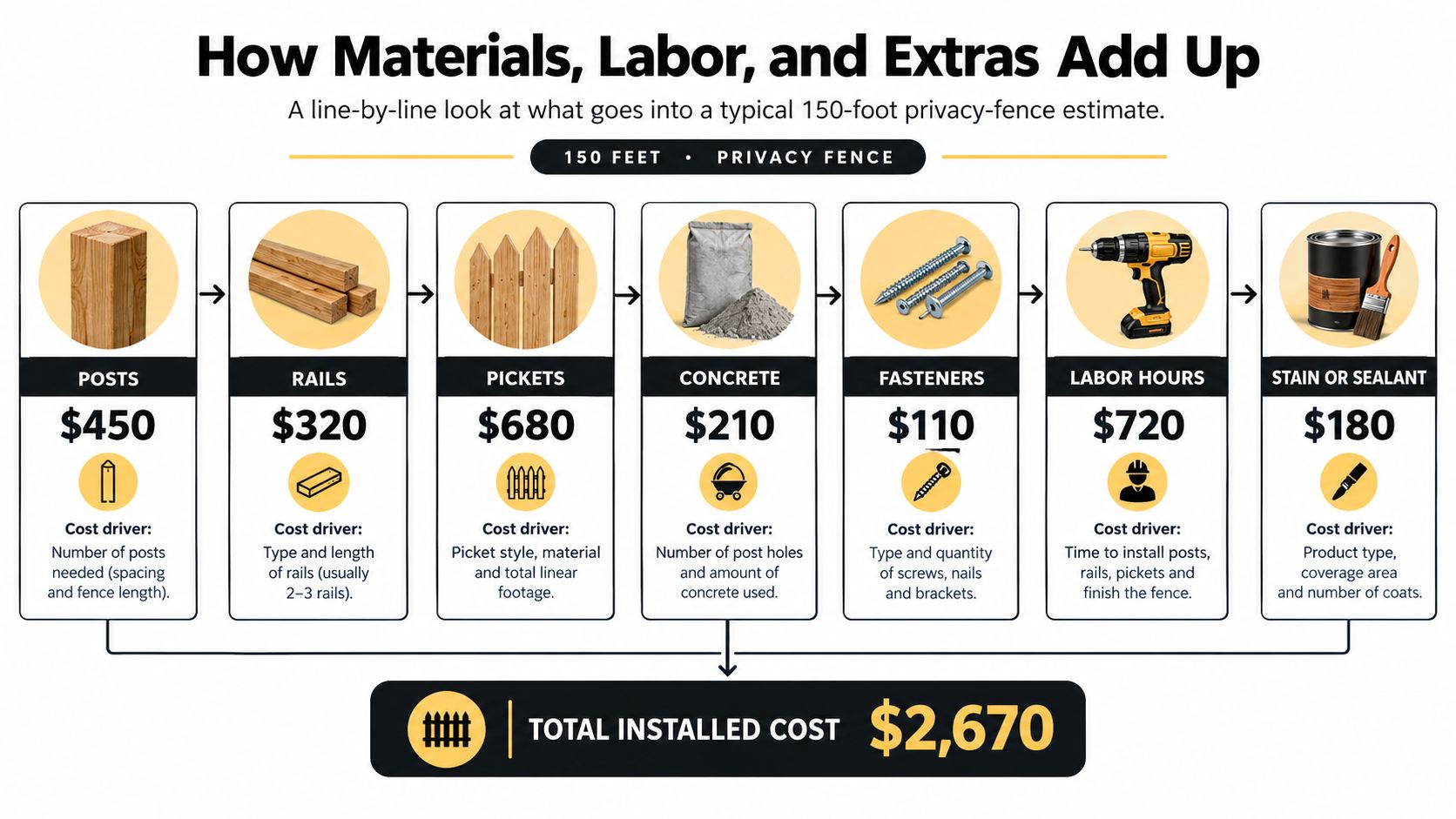
The infographic below lays out how those buckets stack into a project total on a typical privacy job.
Materials Line by Line
Posts are the structure. Everything hangs on them, and they're the component buried in wet ground. Don't let a bid save money here. Rails carry the pickets between posts, and tall privacy fences need enough rails to keep long pickets from bowing. Skimping on a rail saves a little lumber and buys you wavy panels.
Pickets are the visible surface and the largest lumber quantity on a privacy job, which is why species choice moves the total so much. Concrete locks posts against frost heave and wind load. Fasteners and hardware look trivial on a quote, but the wrong screws stain cedar, corrode, and back out, so galvanized or coated hardware matched to treated lumber is worth specifying in writing.
Labor and What You're Actually Buying
You're not buying hours. You're buying layout accuracy, straight lines, plumb posts, consistent picket reveal, and gates that swing and latch in February, not just on install day. Digging and setting posts is the slow, physical core of the job, and it's where soil, roots, and access either keep a crew moving or eat the day.
The video below is useful background on how installation labor sequences on a real job, from layout through setting and building out sections.
When a labor number looks too low, ask what got removed. Sometimes it's cleanup. Sometimes it's concrete on every post. Sometimes it's the second crew member who holds panels true while they're fastened. Labor shortcuts don't show up in photos. They show up in leaning sections two winters later.
Extras That Belong on the Quote
These are the items that turn an agreed price into an argument when they're left vague.
Removal and disposal: Tearing out an old fence, pulling or cutting old posts, and hauling debris is real work with real dump costs, and it should be a named line.
Gates: Count them, size them, and specify hardware, because a wide double gate needs heavier framing and posts than a single walk gate.
Stain or paint: Decide whether finish is included now, priced as an option, or left to you, and get the product type in writing.
Site allowances: Difficult digging, grading along the line, and root or debris removal should be allowances with clear terms, not open-ended surprises.
Contractor's shortcut: If a quote fits on one line, it isn't a quote. It's a guess with a dollar sign.
Companies that do this work regularly will itemize without being asked. 1st Choice Home Repairs, for example, handles fencing alongside decking, painting, and handyman work in the St. Louis suburbs, so fence scope often gets coordinated with adjacent exterior projects on the same visit. Whoever you hire, the standard is the same. Linear footage, height, species, post spacing, gates, demolition, finish, and warranty, all in writing, before anyone digs.
Lifecycle Cost and Why Cheap Pine Can Get Expensive
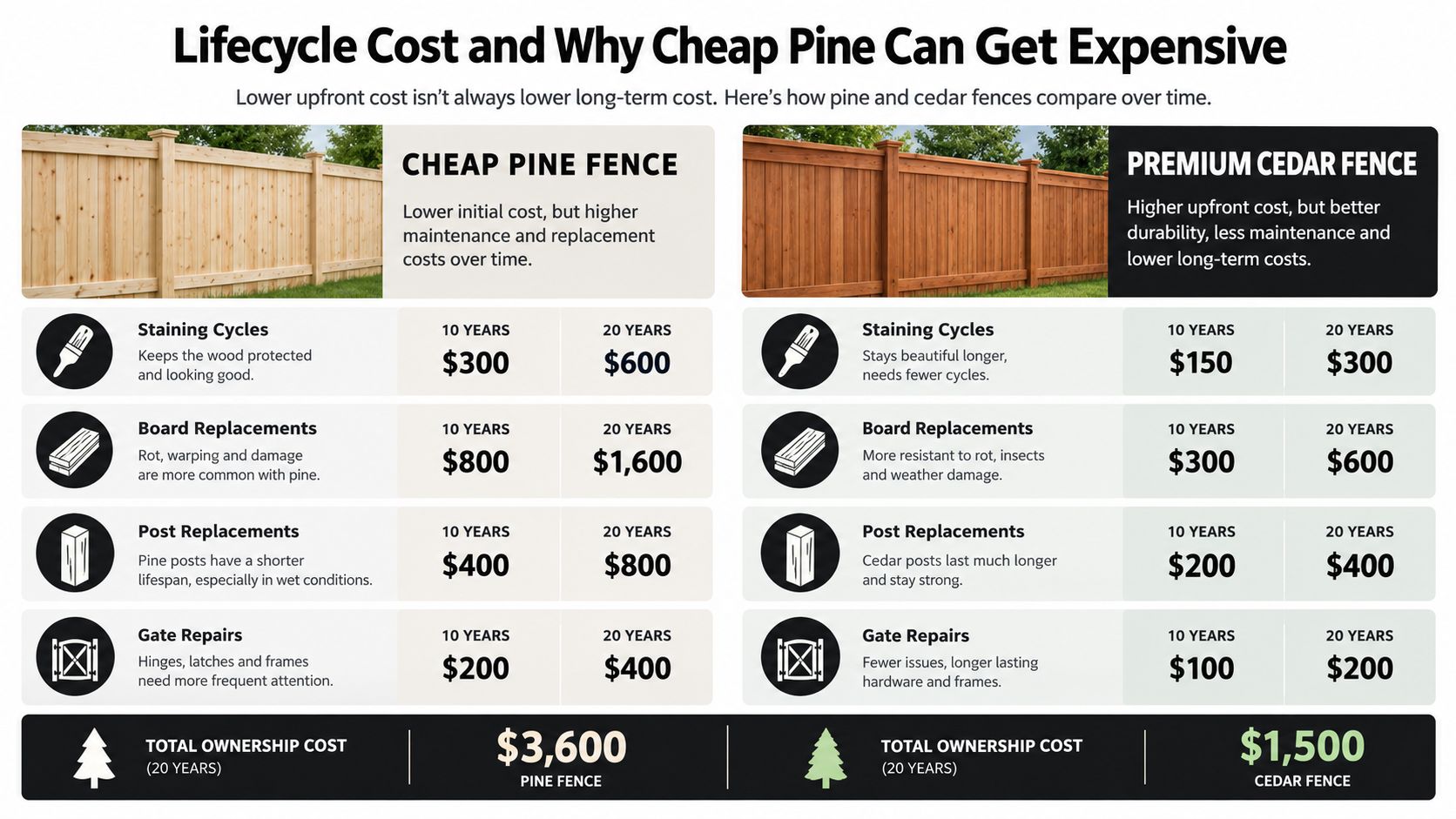
The invoice you sign is the first payment, not the total cost. A wood fence charges you in installments called staining, board replacement, post replacement, and gate repair. Homeowners who price only the first payment routinely buy the most expensive fence on the street.
Run the ownership math over 10 and 20 years instead. Add the install price, staining cycles where the species and finish require them, localized repairs, and eventual replacement of vulnerable components. That annualized view is how landlords and long-term homeowners should judge value, and it's where the pine-versus-cedar answer flips depending on your property.
The comparison below frames that long view, because the gap between the two species is a maintenance story, not just a lumber story.
Where Cheap Pine Stops Being Cheap
Put a bargain pine fence on a shaded, damp, poorly drained lot in a wooded part of Wildwood or Chesterfield. Pickets stay wet, mold and algae colonize the surface, stain breaks down faster, boards warp as they cycle between soaked and sun-baked, and posts sit in moisture that accelerates decay at the ground line. You restain more often, swap boards sooner, and face post replacement years before the pickets wear out. The money you saved at install leaks out in service calls.
Now put that same pine fence on a dry, sunny, well-drained lot in O'Fallon with good air flow and an owner who restains on schedule. It can deliver decades of service and beat cedar on pure economics, because cedar's durability premium never gets tested. Same fence, opposite verdict. Property context decides.
Gates deserve their own mention in lifecycle math. A gate is a moving structure hanging off two posts, and it's the first thing to sag, drag, and stop latching when posts shift or framing is light. Budget for hardware adjustment and occasional gate repair over the fence's life, and pay for proper gate framing and heavy hinges at install to push those repairs further out.
Posts Decide How Long the Fence Lives
Species debates distract from the component that kills fences. Posts carry the wind load and sit in ground moisture, so they rot first and take whole sections with them. Common residential layouts use 4×4-inch posts at approximately 6–8 feet on center, and USDA Forest Service guidance recommends pressure-treated posts rated for below-ground use, or naturally decay-resistant wood, because preservative treatment forces protection into the wood and reduces vulnerability to decay and termites, while above-ground pickets and rails should also be decay-resistant or treated where moisture exposure is high.
That guidance creates a simple rule. Saving money on untreated or inadequately treated posts is the most expensive cut on the quote. Specifying ground-contact-rated treated posts, setting footings below the local frost line in cold climates, and using water-repellent preservative finishes costs a little more at install and protects every other dollar in the fence.
How to Run Your Own 20-Year Comparison
You don't need a spreadsheet with false precision. You need honest assumptions written down.
Start with install price: Use the itemized quote for each option, pine and cedar, built to identical post and footing specs.
Add staining cycles: Count how often each option realistically gets stained on your lot, shaded and damp meaning sooner, and price it at what you'd pay, including your own weekends if you'd do it yourself.
Add repairs: Allow for board swaps, at least some post work on the cheaper build in wet conditions, and gate hardware attention.
Divide by years of service: Annualized cost, not sticker price, is the number to compare.
If the two options land close on annualized cost, buy the one you'll enjoy looking at. If you're selling within a few years, buy the sound pine fence, stain it well, and let the next owner make the 20-year decision.
Reading Contractor Quotes Without Getting Burned
Most fence disputes aren't about craftsmanship. They're about scope that two people thought they agreed on and didn't. A complete written proposal prevents nearly all of them, and you don't need construction experience to audit one. You need a checklist and the willingness to ask plain questions.
What Must Be in Writing
Every proposal you seriously consider should state these items explicitly. Missing items aren't necessarily dishonesty, but they're openings for change orders.
Linear footage and layout: Total feet, where runs start and stop, corners, and tie-ins to the house or existing fencing.
Post specifications: Dimensions, treatment category rated for ground contact, spacing, footing material, and hole depth suited to local frost and soil.
Materials by component: Species and grade for pickets and rails, rail count per section, and fastener and hardware type.
Gates: Number, width, single or double, framing method, and hinge and latch hardware.
Removal scope: Whether the old fence comes out, whether old posts and footings are pulled or cut, and who hauls debris.
Finish: Stain or paint product, coats, timing after install, or an explicit statement that finish is excluded.
Permits and warranty: Who pulls permits and handles inspections or HOA approvals, plus warranty terms for workmanship and materials stated separately.
Line those items up across two or three bids and differences jump out. One contractor's lower total often turns out to be wider post spacing, shallower footings, no removal, and no stain. That's not a better price. It's a smaller fence project wearing the same label.
Red Flags That Deserve a Hard Question
Single-line totals top the list, because there's nothing to verify and nothing to hold anyone to. Vague miscellaneous lines are close behind, since miscellaneous has a way of growing. Unusually low material costs usually mean a lower grade of lumber, fewer rails, or posts that aren't ground-contact rated, and you should ask exactly which product is being priced.
Be equally wary of a bid written without a site walk. A contractor who hasn't seen your slope, your access, or your old fence can't have priced them. And if a price is presented as firm but the proposal is full of allowances with no caps or terms, that price isn't firm.
Ask every bidder the same question. What is not included in this number? The quality of the answer tells you more than the number itself.
Questions That Reveal Local Experience
Ask how deep posts get set in local soil and why. Ask how they handle a sloped run, stepped or racked, and which they recommend for your yard. Ask who pulls the permit in St. Charles, O'Fallon, or Chesterfield and whether your HOA needs approval before digging. Ask what happens when the auger hits rock or an old footing, and how that gets priced.
A contractor who works these suburbs answers without hesitation, because he's pulled those permits and dug that clay. Vague answers suggest a bid written from a template. For homeowners bundling fence work with smaller repairs around the property, it's also fair to ask whether the same crew handles related handyman tasks such as gate adjustments or trim repairs, since one mobilization is cheaper than two.
Treat this process as diligence, not distrust. Good contractors prefer itemized, questioned bids. It protects them from scope creep just as much as it protects you from surprises.
Permits, Add-Ons, and Ways to Bring the Total Down
The fence itself is only part of the check you write. Permits, gates, demolition, and finish work sit around the edges of most quotes, and they're where budgets expand. They're also where smart cuts live, because some add-ons are worth every dollar and others are money spent on the wrong problem.
Permits, Property Lines, and HOA Rules
Permit requirements vary by municipality, and your contractor should verify them rather than assume. Height limits, setback rules, corner-lot visibility restrictions, and finished-side requirements can all dictate design, and building first and asking later risks modifying or removing work you already paid for. HOA approval is a separate gate in many St. Peters, Lake St. Louis, and Ballwin neighborhoods, and it can govern style, height, and color.
Property lines deserve the same respect. If you don't know exactly where your line runs, find out before posts go in the ground. Moving a fence for a boundary dispute costs far more than confirming the line up front. Ask each bidder how they establish the line and what they do when existing fences don't sit on it.
Add-Ons Worth Paying For and Ones to Question
Pay for proper gates. Heavy hinges, a braced frame, and posts set to carry the load prevent the sagging, dragging gate that homeowners curse daily. Pay for removal done right, including pulling old posts where they'll conflict with new footings. Pay for stain or sealant if you know you won't do it yourself in the first season, because unprotected new wood weathers fast and unevenly.
Question decorative upgrades that add lumber and labor without adding function, at least until the core fence is right. Post caps, trim boards, and lattice toppers look sharp, but they don't extend the fence's life the way ground-contact posts and proper depth do. Spend on structure first, decoration second.
Where can you legitimately save labor? Clearing brush and obstacles off the fence line yourself before the crew arrives is honest savings. Handling your own staining, if you'll do it on schedule, removes a real line item. Digging your own post holes in St. Louis clay to save money is a trade most homeowners regret by the third hole, and setting posts plumb in concrete is skilled work that determines whether the fence stands straight.
Real Levers for Lowering the Total
Right-size the height: Use full privacy height where you live outdoors and a shorter, cheaper design where you only need a boundary.
Simplify the layout: Fewer corners, fewer jogs, and gates placed on flat, accessible ground reduce labor without reducing function.
Choose stain on pine over premium cedar: On a dry, well-drained lot you're committed to maintaining, this is a legitimate value play, not a corner cut.
Phase the project: Build the backyard privacy sections now and the side or front sections next season, keeping posts and design consistent so phases tie together cleanly.
Don't cut post quality, footing depth, or gate hardware to hit a number. Those cuts convert directly into early repairs, and you'll spend the savings plus a service call.
Financing the Fence Instead of Shrinking It
Cutting a fence down to fit a cash budget sometimes means buying the wrong fence twice. For homeowners in St. Charles, O'Fallon, Lake St. Louis, Chesterfield, Wildwood, St. Peters, and Ballwin, spreading the cost can be the smarter move, especially when the fence is tied to selling a home, securing a yard for kids and dogs, or replacing a failed fence you can't defer.
Ask contractors what they offer before you assume cash is the only route. Same-as-cash promotions can suit a seller who'll pay the balance at closing. Short-term installment plans fit a defined project with a quick payoff horizon. Longer-term renovation financing makes sense when the fence is part of a larger exterior project with decking or painting. Review the financing options available for local home projects and compare total repayment cost against the cost of phasing or downgrading the fence.
My recommendation is direct. Finance the right fence before you pay cash for the wrong one. A properly posted, properly finished fence at the right height serves you for decades. A cut-rate fence serves you an invoice every few years.
If you're ready to price a fence for your yard in St. Charles, O'Fallon, Chesterfield, Wildwood, or a nearby community, 1st Choice Home Repairs provides fence installation and repair with free project estimates, itemized scope, and financing options to fit your budget. Reach out for a site walk and a written, line-by-line quote that spells out posts, gates, removal, and finish, so you can compare it against any bid with confidence.
Comments