
Washer/Dryer Repair Near Me: A Local Homeowner's Guide

It's 9 p.m. in St. Charles County. The washer has stopped with a load of towels sitting in murky water, the dryer is running but blowing cool air, and tomorrow's school clothes are still waiting. That's more than an annoying appliance glitch. It can disrupt work, family routines, and the small businesses people run from home.
Laundry appliances are part of everyday life for many households, but ownership isn't universal and washers and dryers don't always come as a pair. The U.S. Energy Information Administration counted approximately 112.99 million U.S. housing units with a clothes washer and 111.33 million with a clothes dryer, or about 80.38% and 79.63% of housing units, respectively, in its 2024 Residential Energy Consumption Survey. For households that depend on those machines, a timely diagnosis can restore laundry capacity without rushing into replacement.
When you search for washer/dryer repair near me, the closest listing isn't automatically the right fit. You want a technician who looks at the whole laundry setup, including the appliance, water connections, drain path, electrical or gas supply, and dryer exhaust. The same symptom can have different causes, and replacing a part before identifying the cause can leave the original problem in place.
When the Laundry Room Stops and What That Really Means
A washer full of water can mean wet clothes, a possible leak, and no clear way to finish the cycle. A cold-running dryer can turn one load into several attempts, while a growing pile of towels and uniforms waits nearby. In a busy St. Charles County home, those failures can throw off the next day's plans before anyone knows whether the cause is a small blockage or a more involved repair.
The laundry room works as a small system. The washer needs reliable water flow, a drain that carries water away, and a control system that allows the cycle to advance. The dryer needs clear airflow as well as working heat controls. A kinked drain hose or restricted vent can make a healthy appliance appear to have a major internal failure, so the useful question isn't only “Which part broke?” It's also “What conditions made the machine stop working as it should?”
That's why fast local service matters. A technician who serves St. Charles, O'Fallon, Lake St. Louis, St. Peters, Chesterfield, Wildwood, and Ballwin can assess the appliance in its actual setting, not just infer the cause from a symptom over the phone. Local availability can help a household get an appointment sooner, but a sound diagnosis still takes priority over a hurried parts swap.
Practical rule: If a machine stops mid-cycle, note what it was doing and what you saw. Water left in the drum, a flashing error code, a burning smell, or a dryer that's unusually hot are useful clues for the technician.
This guide covers common washer and dryer symptoms, how repair quotes are built, and how to decide whether a repair makes sense for the appliance you own. It also walks through what a service visit involves, what to ask about warranties and payment options, and how to arrange local help. The aim is a clear diagnosis and a decision that fits your home and budget, not a reflexive recommendation to replace a machine.
The Problems a Local Repair Tech Sees Every Week
A symptom points toward possible causes, but it doesn't identify a failed part by itself. In homes around St. Charles, O'Fallon, Lake St. Louis, Chesterfield, Wildwood, St. Peters, and Ballwin, the first useful step is to describe exactly what the machine does: when the cycle stops, whether water remains, what sounds you hear, and whether an error code appears.
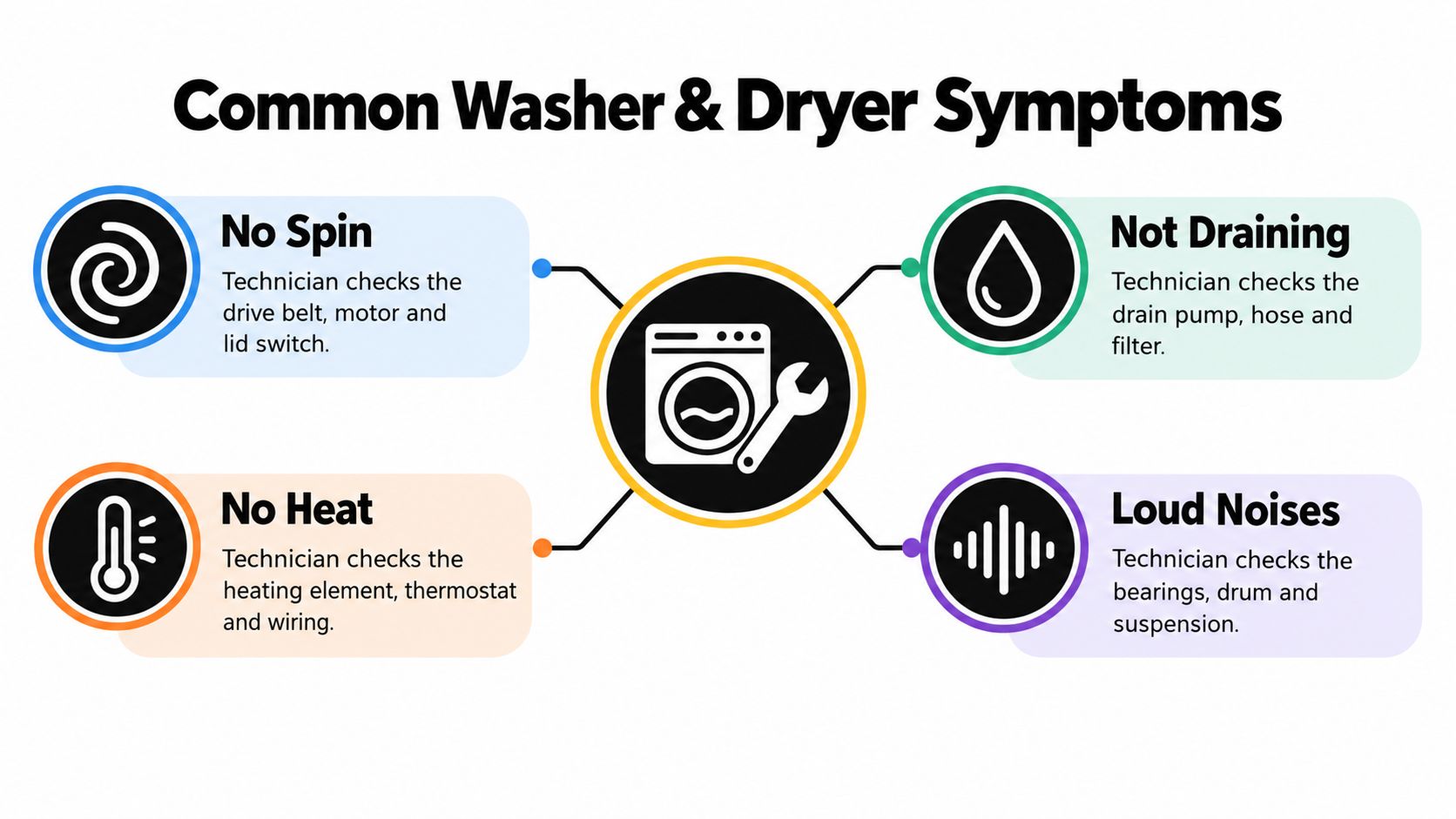
Washer symptoms and first checks
Washer won't drain. Water left in the drum can point to a clogged pump filter, debris in the drain pump, or a restricted or kinked drain hose. Some machines won't enter the spin stage until they've drained, so a drainage fault can look like a spin problem too. Don't pull the machine out while it's full without considering how you'll contain the water.
Washer won't spin or leaves clothes very wet. An unbalanced load can interrupt a spin cycle, but the cause may also involve a drain restriction, door-lock switch, pressure-sensing issue, belt, or motor. Modern washers use load sensing and electronic controls, so a sound diagnosis checks the machine's behavior and its error codes rather than assuming the motor has failed. ENERGY STAR describes the load sensing, variable fill, and high-speed extraction systems used in efficient washers in its clothes washer product guidance.
Washer is leaking. Check whether water appears near the supply hoses, drain hose, door seal, or beneath the cabinet, but don't reach into a wet area near electrical connections. A loose hose connection can be very different from a damaged pump or seal. Knowing when the leak occurs, during filling, washing, or draining, can help narrow the inspection.
Washer shakes or makes a loud noise. A load that's bunched on one side or a machine that isn't level may produce vibration. Persistent banging, grinding, or squealing can point to worn suspension, bearings, a pulley, or another mechanical issue. Stop the cycle if the washer shifts across the floor or the noise suddenly changes.
Dryer symptoms and safety
A dryer that tumbles but doesn't dry well isn't automatically suffering from a failed heating element. Airflow and controls matter just as much. A clogged lint screen, crushed transition duct, obstructed exterior hood, weak blower, thermostat, or thermal fuse can all affect drying. The U.S. Consumer Product Safety Commission identifies insufficient heat as the most commonly reported dryer problem in its survey data, at 18%, and notes that lint accumulation is also a leading complaint. It also identifies failure to clean as the leading ignition factor in dryer fires, according to its clothes dryer safety report.
A dryer that needs repeated cycles may have restricted exhaust airflow, a heating or temperature-control fault, or another performance problem. The diagnosis should include the vent route as well as the appliance itself. A heating element or gas igniter may be involved, but replacing either without checking airflow can miss the underlying issue.
Stop using the appliance if you notice a burning smell, scorch marks, sparking, a gas odor, or repeated breaker trips. If you smell gas, avoid operating switches or the appliance and contact the appropriate emergency or utility service. Don't keep restarting a dryer that overheats or smells scorched. For help with related home repairs beyond appliances, 1st Choice Home Repairs' handyman services are another local service option.
For a visual overview of common dryer warning signs and checks, watch this explainer.
What Washer and Dryer Repair Costs in 2026
A washer can stop draining while the dryer beside it still runs, but a repair quote should explain the fault and the work needed to fix it. The total may include a diagnostic or service-trip fee, labor, parts, and an extra charge for after-hours or expedited scheduling. Ask whether the diagnostic fee is credited toward the repair if you approve it. Check whether tax and other charges are included in the estimate.
National figures provide context, not a St. Charles County price list. Consumer Reports surveyed 86,609 dryer owners and found that the most common complaint was that the dryer wasn't drying, affecting 12% of owners. Reported median repair costs ranged from $116 to $200, depending on dryer type and price tier, before a commonly added $120–$170 service charge, according to its dryer repair-or-replace guidance. Those numbers don't price a specific local fault. The final bill depends on the diagnosis, the part, access to the appliance, and whether the laundry room's water connections or dryer vent need attention.
Get a written, itemized estimate
A written estimate should name the diagnosis, parts, labor, service fee, warranty terms, and any charges that could change if another fault is found. Don't accept a dollar range for a part as a substitute for explaining how the technician tested it. Ask these questions before approving the work:
Drain pump: Was the pump tested, and were the filter, drain hose, and household drain checked for a restriction?
Belt: Is the belt visibly damaged, and was the drum checked for an obstruction or another failed drive component?
Heating element: Were the vent path and temperature controls checked before the element was identified as the cause?
Thermostat: Which thermostat or temperature-control part failed, and what test confirmed it?
Control board: Were the wiring, sensors, and stored error codes checked before recommending a board replacement?
Parts availability affects both timing and cost. Ask whether the part is in stock and whether the repair can be completed in one visit. If it must be ordered, the provider should explain the next step and any added cost. A delayed repair does not, by itself, mean the appliance is unsafe; that judgment should follow the inspection.
The lowest quote isn't always the best value. A cheap estimate without a clear diagnosis or workmanship coverage can leave the original cause unresolved, leading to another service call. Compare complete written estimates, including what the warranty covers and what happens if the repair doesn't resolve the symptom. In a St. Charles County laundry room, the repair also needs to fit the space's airflow and water setup, not just replace a part.
Repair or Replace and How to Decide
The repair-or-replace choice depends on more than the appliance's age. Start with the fault, the quoted total, warranty coverage, parts availability, safety, and the machine's overall condition. A single serviceable component, such as a pump, belt, or heating component, may justify repair; multiple failures or a major structural problem can change the calculation.
The familiar 50% rule can be a quick prompt: compare the repair quote with the cost of a comparable replacement. But don't treat it as an automatic verdict. A newer machine with a repairable fault and parts available may be worth fixing even when the bill feels substantial. An older appliance with recurring failures, a difficult-to-source control board, or a safety concern may not be a good candidate for another repair.
Count operating efficiency, not just today's bill
Efficiency can strengthen the case for keeping a newer washer in service. ENERGY STAR says certified clothes washers use about 20% less energy and roughly 30% less water than standard models. A full-sized certified washer uses about 14 gallons per load, compared with about 20 gallons for a standard machine, and ENERGY STAR estimates lifetime savings of around $550 per certified washer. See the agency's laundry efficiency fact sheet.
Those figures describe certified machines, not every washer, and they don't mean replacement always saves money. Repairing a newer, efficient appliance can preserve the value already built into it. Replacing an older standard machine may reduce water and energy use, but the purchase price and installation costs still belong in the household's calculation.
Decision factor | Repair leans reasonable when… | Replacement deserves a closer look when… |
|---|---|---|
Failure type | The fault is isolated and serviceable. | The diagnosis involves major structural damage or several failed systems. |
Age and condition | The machine has otherwise been reliable. | Other problems are appearing alongside the current failure. |
Efficiency | A newer, efficient appliance still meets your needs. | An older model uses more resources and performs poorly. |
Warranty and parts | Coverage applies or the part is available. | Coverage has ended and parts are difficult to obtain. |
Safety | The technician can complete a safe, verified repair. | The appliance has a serious unresolved safety issue. |
Before approving the work, ask for the diagnosis and total quote in writing. Then compare that figure with the cost of a suitable replacement, not just the cheapest new model you can find. Include likely delivery or installation costs, the machine's operating performance, and whether a repair would restore dependable use.
A repair isn't automatically the greener choice, and replacement isn't automatically the smarter one. When one common component fails in an otherwise sound machine, repair can keep a usable appliance in service without buying a replacement by default.
What Happens During a Same-Week Service Visit
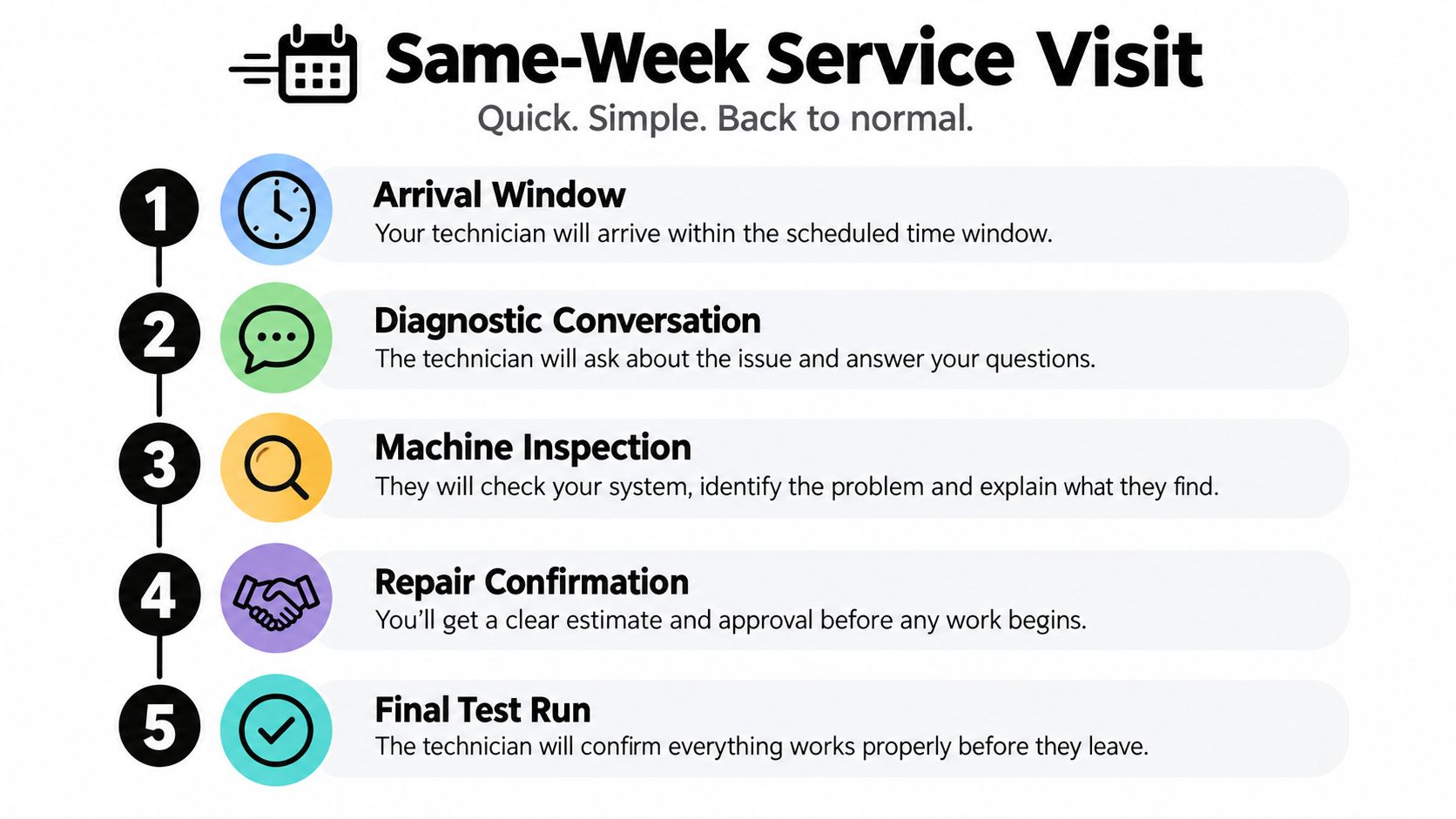
A useful repair visit starts with a conversation, not a parts order. The technician should ask what happened, when the symptom began, whether it's consistent, and whether you've seen an error code, leak, unusual noise, odor, or breaker trip. If the appliance has a history of recent repairs, share that too. It can change which checks make sense first.
After discussing the symptoms, the technician should make the area safe. That may mean isolating power, shutting off water before opening a washer connection, and checking for gas concerns when working around a gas dryer. The surrounding floor and connections matter as well. Water near an outlet, a loose appliance, or a damaged vent can affect how the work proceeds.
What the diagnosis should include
For a washer, expect the technician to review error codes and check inlet flow, draining, the pump and filter, door-lock operation, pressure sensing, and spin behavior. Those checks help separate a hydraulic or control issue from a motor, bearing, or tub problem. ENERGY STAR explains that efficient washers use load sensing, variable fill levels, high-speed extraction, and electronic control logic, which is why a technician should verify system behavior before recommending parts in its clothes washer guidance.
For a dryer, the technician should inspect the lint screen and accessible vent path, verify exhaust airflow, and test temperature controls such as thermostats and thermal fuses. If the diagnosis points toward a heating element or gas igniter, those components should be tested rather than replaced by guesswork. A complete evaluation considers the duct route and exterior vent, not just the cabinet.
If the needed part is available, the technician may complete the repair during the first visit, then test the machine through the relevant function. A less common or model-specific part may require a return appointment. That's not automatically a warning sign. Clear communication about availability, timing, and cost is more useful than a promise that every fault can be fixed immediately.
Prepare the room and ask before approval
You can make the visit more efficient by clearing access to the machines and moving laundry out of the drum. Secure pets, and have the model information and any error code ready if you can find them safely. Before work begins, ask what has been diagnosed, what the quoted total includes, whether parts are in stock, and what warranty applies.
A technician shouldn't manufacture urgency to push an approval. If the appliance presents a real safety concern, you should hear which observation supports that warning and what to do while the repair is pending. Before the technician leaves, ask to see the appliance run or otherwise confirm that the repaired function has been tested.
Warranties, Financing, and How to Keep Repair Affordable
A coverage plan can change who pays for parts, labor, or a return visit. Manufacturer warranties may cover a component but exclude service labor. A repair company's workmanship warranty applies to its repair under written terms, while an extended plan or home warranty may require approval or a specific service process. Check which coverage applies before authorizing work, since these protections are not interchangeable.
Ask for the workmanship warranty in writing. Confirm which parts and labor it covers, how long coverage lasts, and what exclusions apply. A verbal promise may not cover a repeat visit or replacement part. If the appliance is still under manufacturer coverage, check its documentation and ask whether using an independent provider affects the specific coverage involved.
Use financing as a payment option, not a repair recommendation
Financing can spread the cost of a repair, but the payment option should not determine whether the repair makes sense. Get the diagnosis and full price first. Then compare the plan's interest, fees, required payments, and late-payment consequences with paying directly or choosing another solution.
In St. Charles County, a repair's value can depend on more than the failed part. Consider whether the appliance is likely to work reliably after repair and whether problems with the laundry room, such as restricted dryer airflow or a water connection issue, could lead to another service call. Financing may help manage the upfront cost, but it does not make a poor repair choice more worthwhile. Review 1st Choice Home Repairs' financing details and read the terms before committing.
Before approving the work, ask:
Total price: What is the full amount, including diagnosis, labor, and parts?
Coverage: What does the workmanship warranty cover, and how do I request service if the problem returns?
Payment terms: Are there fees or interest, and what happens if a payment is late?
Repeat failure: If the same symptom returns, will the company recheck the repair under warranty?
Clear answers make it easier to compare the repair with replacement and choose based on the appliance's condition and your budget.
Local Coverage, FAQs, and Booking Same-Week Service
A local technician can assess the machine in its actual laundry room, including its supply connections, drain setup, and dryer vent route. 1st Choice Home Repairs serves St. Charles, O'Fallon, Lake St. Louis, Chesterfield, Wildwood, St. Peters, Ballwin, and nearby communities. Scheduling depends on current availability, so confirm the appointment window directly rather than assuming a visit can happen on a particular day.
Questions homeowners ask
How soon can I get a same-week appointment? Availability changes with the schedule and the nature of the repair. Call with the appliance type, model information, symptoms, and your location so the provider can check the nearest appointment options.
Should dryer vent cleaning happen during the repair? Ask the technician to inspect the vent path when drying is poor or airflow appears restricted. Appliance repair and full vent cleaning may be separate services, so confirm what the appointment includes before booking.
What information should I have ready? Note whether the machine drains, spins, heats, or stops mid-cycle, along with any error code, leak, unusual sound, or odor. A model number can help identify the appliance and determine whether a likely part may be available.
Do landlords and property managers get priority scheduling? Ask the company about scheduling for rental properties and how it coordinates access with tenants. Don't assume priority service unless the provider confirms it.
If the washer is holding water, the dryer is running cold, or a safety warning has appeared, contact a local provider and describe what you observed. You can ask about service availability and the next steps through 1st Choice Home Repairs' contact page.
1st Choice Home Repairs provides washer and dryer repair for homes across St. Charles County and nearby communities, with upfront communication about the diagnosis and proposed work. If laundry has stalled, visit 1st Choice Home Repairs to discuss the symptoms and request a same-week service appointment.
Comments