
Repair Clothes Dryer Near Me Fast Local Hiring Guide

You've got a basket of damp clothes, a dryer that sounds like it's working, and somewhere else to be. Maybe the drum turns but never gets warm. Maybe one load now takes two cycles. Maybe the machine has started making a squeal that you can hear from the next room. Searching repair clothes dryer near me is easy. Knowing whether you need urgent service, vent cleaning, a component repair, or a replacement takes a little more judgment.
For households and rental properties in St. Charles County and West St. Louis County, the fastest sensible decision starts with triage. This guide shows you what the dryer is supposed to do, which symptoms signal a safety problem, how restricted airflow can imitate a failed part, and what to ask before hiring a local technician. It also gives you a practical way to compare repair and replacement without guessing.
When Your Dryer Quits Right When You Need It Most
Laundry problems rarely arrive at a convenient time. A family may be preparing for school and work, a landlord may have a tenant waiting for a usable laundry room, or a homeowner may be trying to finish linens before guests arrive. The dryer may still hum and tumble, which makes the problem especially frustrating. It looks operational, but the clothes come out cold, damp, or only partly dry.
That distinction matters. A dryer that tumbles but doesn't dry could have an airflow restriction, a failed heating element, a thermal-fuse shutdown, a sensor problem, an electrical issue, or, in a gas model, a burner or ignition fault. Replacing the first part that seems suspicious can waste money if the actual problem is a crushed hose or blocked exterior vent.
Start with a safety decision
Before you search for an appointment, decide whether the dryer is merely inconvenient or potentially unsafe.
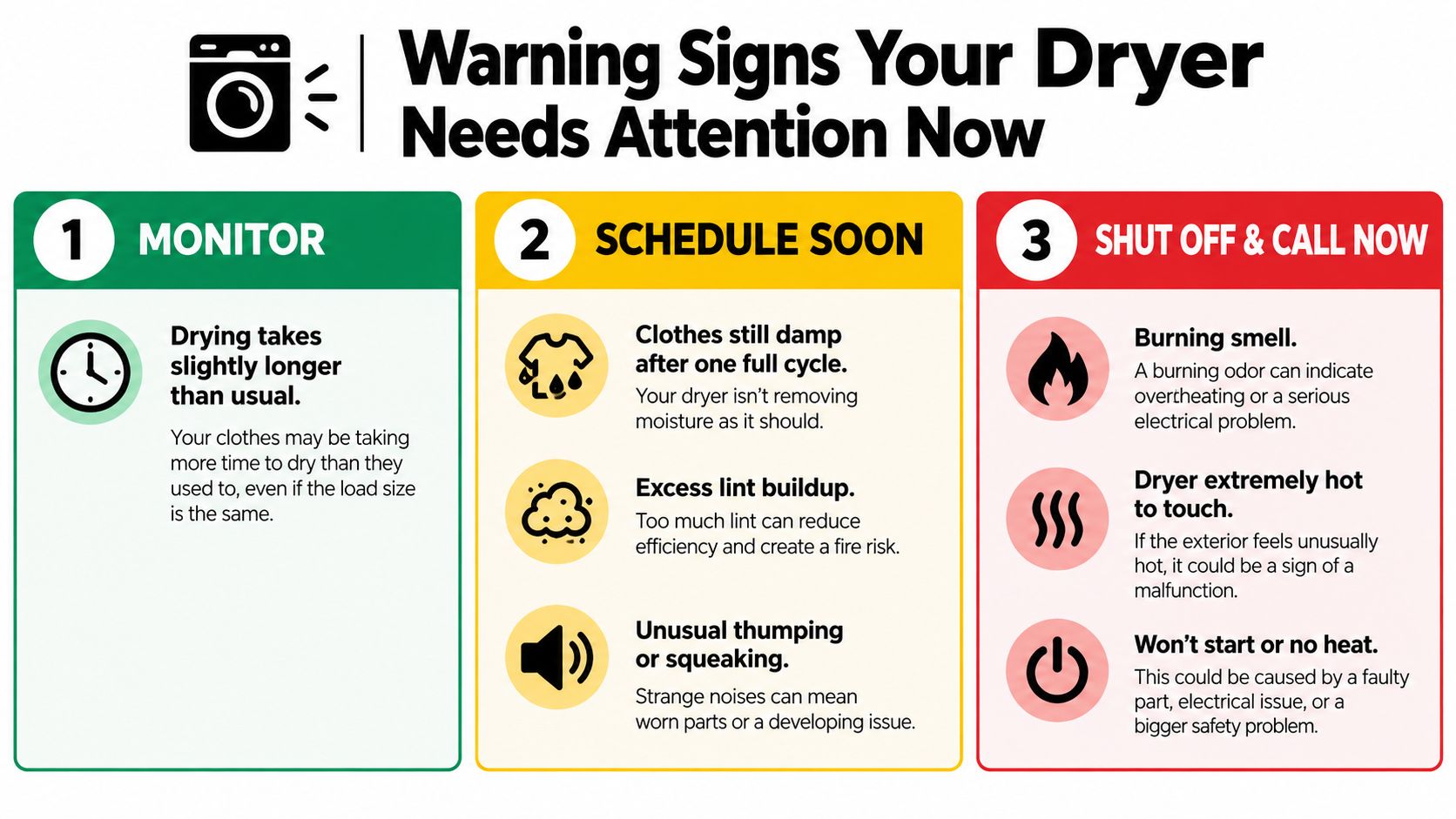
A performance problem: Clothes take longer to dry, but there's no burning odor, smoke, sparking, or extreme heat. You can stop the cycle, clean the lint screen, and schedule a visit.
A service-soon problem: The dryer leaves clothes damp, makes a new thumping or squealing sound, or shuts down repeatedly. Stop relying on it for normal loads and arrange diagnosis.
An urgent safety problem: You notice sparks, a burning smell, smoke, an unusually hot cabinet, or a breaker that trips again after resetting. Turn the dryer off, unplug an electric model if you can do so safely, avoid operating a gas model, and call a qualified professional.
The safety concern isn't theoretical. The National Fire Protection Association estimated that dryers were involved in 13,820 home structure fires per year from 2014 to 2018, with 7 deaths, 344 injuries, and $233 million in annual property damage during that period, as summarized by dryer fire and repair safety information. Lint, heat, and restricted exhaust airflow can turn a drying complaint into a home hazard.
What this guide helps you decide
You don't need to diagnose a control board from the kitchen floor. You need enough information to explain the symptom, perform safe checks, and judge whether a provider is testing the cause instead of guessing.
Write down what happened, when the problem started, whether the drum tumbles, whether heat is present, and whether the dryer stops before the cycle ends. Have the model number available. A clear symptom history helps a local technician arrive prepared and reduces the chance of a vague, open-ended visit.
How a Clothes Dryer Actually Works in Plain Language
Think of a dryer as a hair dryer inside a rotating box with an exhaust straw. The hair dryer supplies heat. The box tumbles the clothes. The straw carries damp air outside. If any part of that loop fails, drying slows or stops.
Four systems work together:
Heat: An electric dryer uses a heating element. A gas dryer uses a burner. Both warm the air entering the drum.
Tumbling: The drum rotates, lifting and dropping fabric so hot air can reach more of the load.
Airflow: A blower moves air through the drum. That moving air picks up moisture from the clothes.
Exhaust: The vent hose and duct carry warm, damp air outdoors.
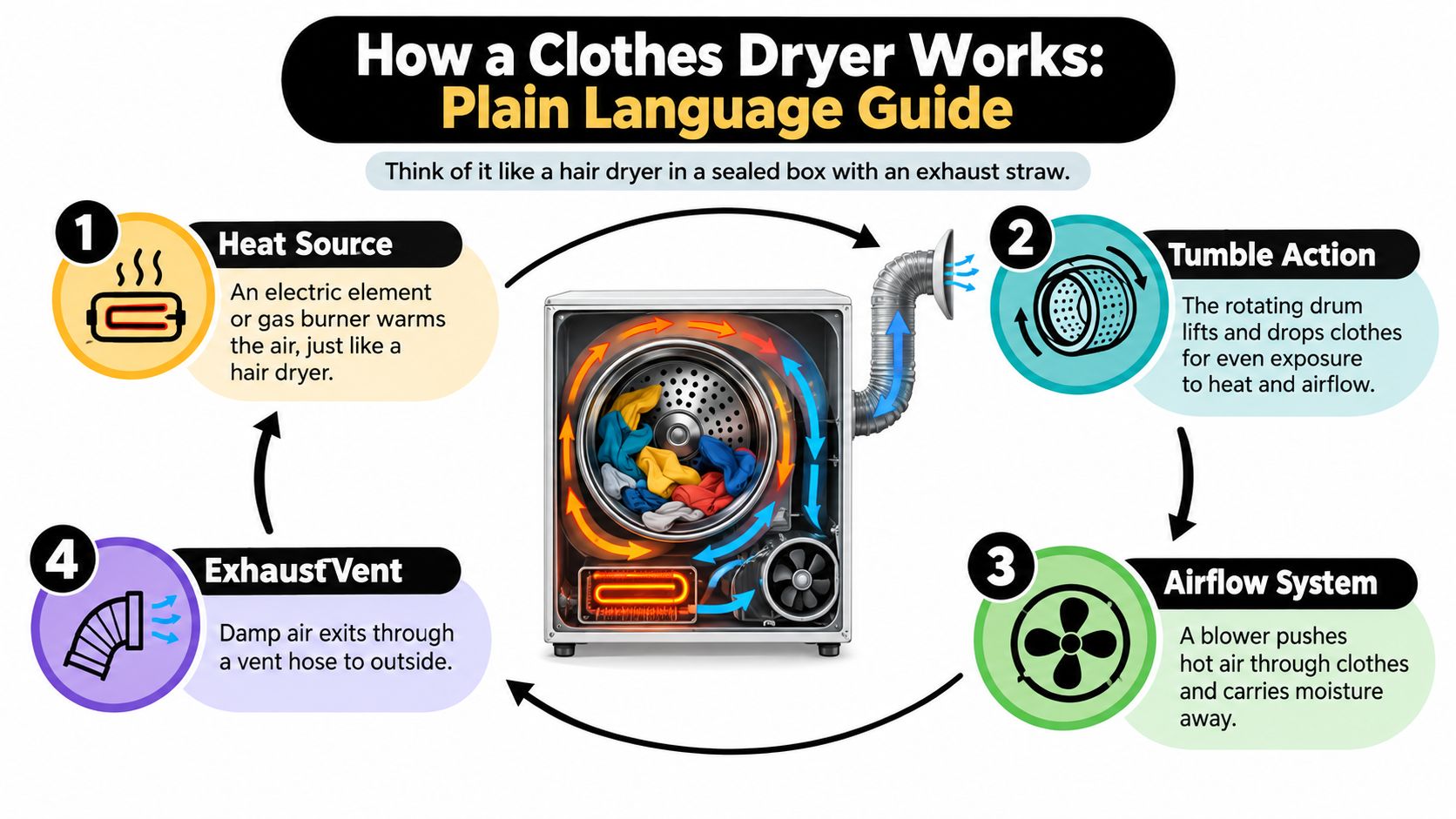
The airflow loop: The dryer must heat air, move it through tumbling clothes, collect moisture, and push that damp air outside. A blockage anywhere after the drum can make a working heater look broken.
Why tumbling doesn't prove the dryer is healthy
The motor can turn the drum even when the heating system has failed. That's why a dryer can sound normal while producing cold air. An electric model may also receive enough power for the motor and controls while lacking the full supply needed by the heater. A gas model can tumble while its igniter, flame sensor, or burner fails to produce heat.
The reverse can happen too. A dryer may generate heat but fail to remove moisture efficiently. A clogged lint screen, crushed flexible hose, blocked outdoor flap, or failing blower reduces the air leaving the machine. Moisture stays inside, temperatures rise, and the dryer may shut down through a safety device.
Where sensors fit
Many modern dryers use moisture sensors to decide when clothing is dry. These sensors need clean contact with the load and can behave poorly when covered with residue or when the sensor itself fails. A cycle that ends early doesn't always mean the heater is weak. The control may be receiving the wrong moisture signal, or the load may be arranged so the sensor no longer reads it accurately.
The practical lesson is simple: a symptom describes the result, not the failed component. A technician should inspect the lint path and exhaust, verify vent integrity, and test electrical continuity before replacing a fuse, element, thermostat, or control.
Warning Signs Your Dryer Needs Attention Now
A dryer's most useful warning is often a change from its normal behavior. Don't focus only on whether it turns on. Listen for new sounds, notice how hot the cabinet feels, and pay attention to how long ordinary loads take.
Monitor briefly, then investigate
Slightly longer drying can follow a heavy load, a different fabric mix, or a lint screen that needs cleaning. Remove lint from the screen, confirm the selected cycle uses heat, and check whether air is moving from the outdoor exhaust while the dryer runs. U.S. safety guidance recommends checking that exhaust air is escaping outdoors, as explained in dryer vent safety guidance.
Don't place your hand inside the drum to judge heat, and don't dismantle the cabinet for a casual inspection. If performance returns after the safe checks, monitor the next loads. If the change persists, schedule service rather than repeatedly running the dryer and hoping the issue clears.
Schedule service soon
Clothes that remain damp after a full cycle point toward an airflow restriction or a heating problem. Start with the lint filter, then look behind the dryer for a kinked or crushed hose. Check the exterior vent for visible blockage and confirm the flap opens while the machine operates.
New thumping, rumbling, squealing, or grinding also deserves attention. A foreign object in a pocket can make noise, but a repeated sound that follows drum rotation may indicate a worn roller, belt, idler pulley, or bearing. Continued use can turn a smaller mechanical repair into a broader failure.
Excess lint around the appliance or at the outdoor termination is another reason to book service. A dryer vent can be restricted inside a wall or long duct even when the visible section looks clear.
Shut it off and call now
Stop using the dryer if you smell burning, see sparks, notice smoke, feel extreme cabinet heat, or experience repeated shutdowns. Don't keep restarting it to finish the load. A thermal fuse can open after overheating, but replacing that fuse without finding the cause may lead to another shutdown. Troubleshooting guidance for thermal-fuse failures identifies restricted airflow, damaged vent hoses, blocked exterior vents, blower problems, and shorted heating elements as conditions that require diagnosis rather than blind parts replacement.
If the machine smells hot, looks electrically damaged, or keeps shutting itself down, the laundry can wait. Turn the appliance off and arrange professional evaluation.
A safe pre-call check is limited to external steps: clean the lint screen, verify the cycle setting, inspect the accessible hose, and look at the outdoor vent. Don't open a gas burner assembly or work inside a dryer connected to high-voltage power unless you're qualified to do so.
Repair or Replace and Vent Cleaning or Part Replacement
Homeowners often ask two questions at once: “Should I repair this dryer?” and “Does it need a new part or just a vent cleaning?” The answer depends on age, symptom pattern, safety condition, and the total estimate.
Dryers commonly last about 10 to 13 years, although some appliance life tables place the average closer to 14 years for standard-size models, according to dryer lifespan and repair guidance. Consumer Reports says dryers tend to run for “a decade or so” and reports median repair costs of $116 to $200 for gas dryers and $118 to $188 for electric dryers, depending on model price tier, in the same source.
A modest repair on a younger or well-maintained unit may make sense. An older dryer with repeated failures, cabinet damage, or a repair estimate approaching replacement territory deserves a more careful comparison. Cost guides place typical dryer repairs around $100 to $430, while service-call and labor fees commonly account for a meaningful portion of the bill, according to dryer repair cost guidance.
Compare the likely paths
Scenario | Likely Cause | Best Next Step | Why It Saves Money and Risk |
|---|---|---|---|
Dryer tumbles, but clothes need much longer | Restricted lint path, crushed hose, blocked exterior vent, or weak airflow | Inspect accessible vent areas and arrange airflow testing or cleaning | It avoids buying a heating element when the heater may be working |
Dryer is hot outside or shuts down | Exhaust restriction, failing blower, thermostat issue, or electrical fault | Stop using it and request safety-focused diagnosis | It addresses overheating before another cycle adds more heat |
No heat after airflow checks | Heating element, thermal fuse, thermostat, power supply, igniter, or burner issue | Have the technician test the relevant circuit and component | Testing prevents a replacement part from masking the real failure |
Older dryer has several unrelated faults | End-of-life wear or accumulated component failures | Compare the complete repair estimate with replacement options | It prevents repeated service costs on a machine nearing the end of its useful life |
Dryer makes a persistent mechanical noise | Roller, idler pulley, belt, bearing, or motor problem | Schedule inspection before the drum or motor suffers further damage | Early mechanical diagnosis can limit the repair scope |
Professional vent cleaning averages about $145, while major repairs such as heating-element or motor work can cost substantially more, based on dryer maintenance and repair cost information. The important point isn't that cleaning always solves a no-heat complaint. It's that airflow should be tested before a technician condemns the heater.
For local appliance and home service options, you can review 1st Choice Home Repairs laundry services as one place to begin comparing support.
What to Expect During a Local Dryer Repair Visit
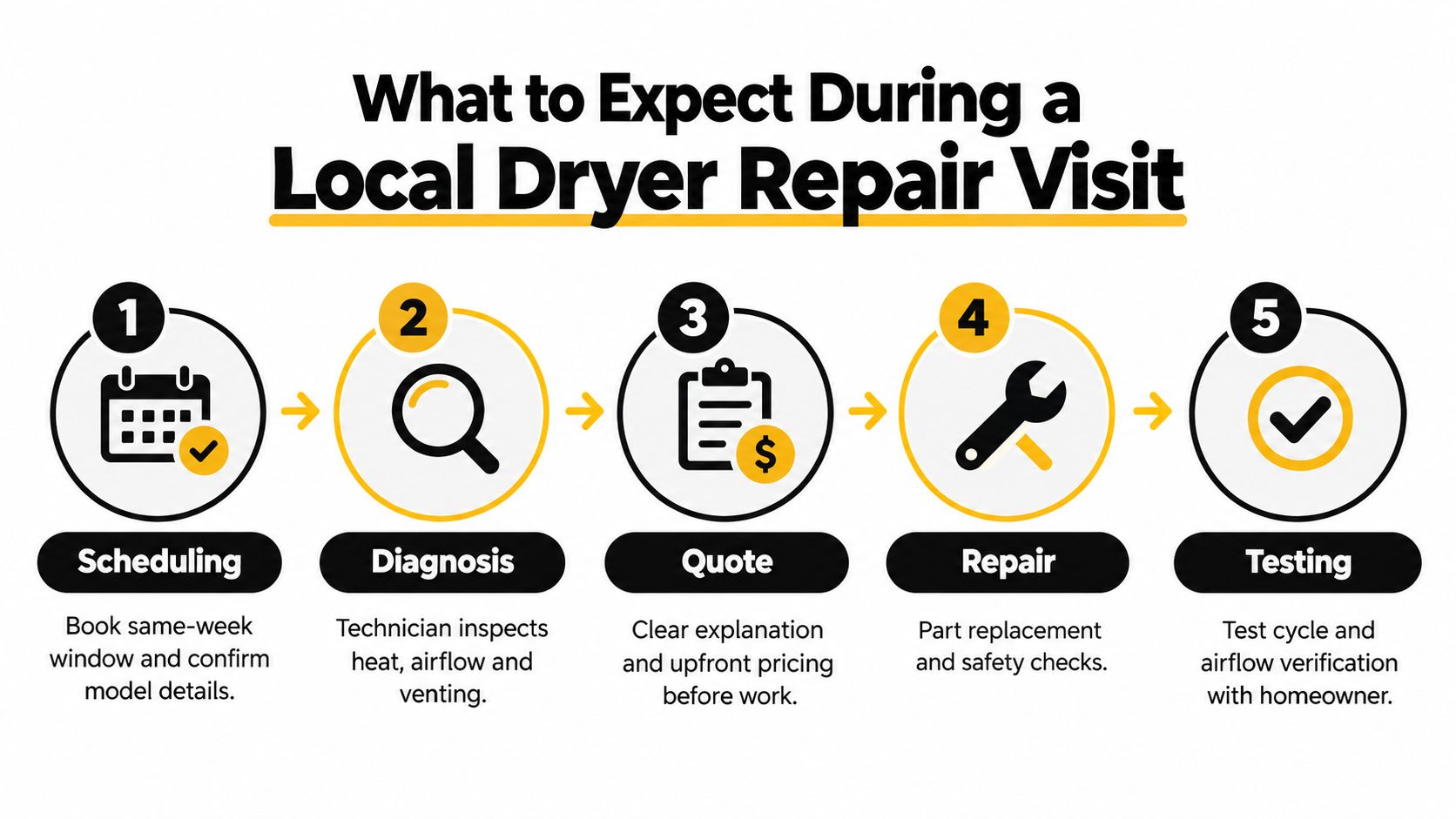
A good service call should feel like a diagnosis, not a parts lottery. You explain the symptom, the technician examines the system, and you receive a clear price before approving the work.
Before the appointment
When you call, describe the event in practical terms. “It doesn't work” is less useful than “the drum turns, the clothes stay cold, and the exterior vent has weak airflow.” Tell the provider whether the dryer is electric or gas, whether it stops during a cycle, and whether you've noticed heat, odor, noise, or a tripped breaker.
Keep the model and serial information accessible. A photo of the rating plate can help the office identify the correct parts. Clear the area around the dryer, preserve access to the vent connection, and remove clothing from the drum.
During diagnosis
The technician should begin with observation and testing. That can include checking the lint screen, exhaust path, exterior vent, hose condition, blower operation, heating system, thermostat circuit, thermal fuse, and electrical continuity. Gas models also require careful attention to ignition and burner operation.
A thermal fuse is a useful example of why testing matters. The fuse may be open because the dryer overheated, but restricted airflow may have caused that overheating. Replacing the fuse alone can leave the original problem in place.
Ask this before approving work: “What caused the failure, and what tests confirmed it?”
The provider should explain whether the recommended work involves cleaning, adjustment, a replacement part, or a larger repair. Service-call fees and labor can add $50 to $130 before parts, according to the maintenance cost information cited earlier, so ask whether the diagnostic fee applies to approved labor and whether additional charges require your authorization.
After approval and repair
Many common repairs can be completed during the initial visit when the correct part is available, but timing depends on the model, access, diagnosis, and part availability. Don't accept a promised completion time without asking what could delay the work.
At the end, the technician should run the dryer, confirm drum movement and heat, inspect airflow, and explain any maintenance recommendation. Ask for an itemized invoice, the part and labor coverage, and the workmanship warranty terms.
For broader home repair support, 1st Choice Home Repairs handyman services offers another local service category to review when appliance work overlaps with installation or home access needs.
How to Choose a Trustworthy Dryer Repair Service Nearby
Search results can give you names, but they can't make the hiring decision for you. A provider who answers quickly but won't explain the diagnostic process may create more uncertainty than a provider who takes a little longer to give a complete answer.
Start with service-area confirmation. Ask whether the company regularly serves St. Charles, O'Fallon, Lake St. Louis, Chesterfield, Wildwood, St. Peters, and Ballwin, rather than assuming a map listing covers your address.
Use a short comparison checklist
Contact two or three providers when the dryer isn't an immediate safety emergency. Ask the same questions so the answers are comparable.
Experience: Does the technician work on your dryer brand and model type?
Fuel system: Does the company handle both electric and gas dryers, and who performs gas-related diagnosis?
Airflow testing: Will the technician inspect the lint path, vent hose, exterior termination, and blower before recommending a heating part?
Pricing: Is the service-call fee explained, and will you receive a written estimate before repair?
Parts: Will the provider identify whether the part is original, manufacturer-approved, or an equivalent replacement?
Warranty: What does the warranty cover, and for how long? Is it limited to parts, labor, or both?
Follow-through: Who do you contact if the same symptom returns?
Property care: Will the technician protect flooring, move the dryer carefully, and clean up lint or debris?
Read reviews for patterns, not just stars
Look for repeated comments about punctuality, communication, diagnosis, cleanup, and whether the final bill matched the approved estimate. One complaint doesn't establish a pattern, but several comments about unexplained charges or pressure to replace an appliance deserve attention.
Landlords should also ask how invoices and tenant scheduling are handled. A useful provider can document the symptom, cause, repair, and recommended follow-up in language that helps with maintenance records.
Notice the red flags
Be cautious if a company recommends a heating element without checking airflow, refuses to provide any estimate before work begins, can't explain the service area, or pressures you to replace a dryer without discussing age and repair condition. Vague answers about gas safety, electrical testing, or warranty coverage should also stop the conversation.
The right provider doesn't need to promise that every dryer can be saved. They should show how they reached the recommendation and give you enough information to choose repair, cleaning, or replacement with confidence.
Your Next Step to Fast Reliable Dryer Repair With 1st Choice
A reliable dryer decision starts with three questions. Is it safe to keep running? Is the problem airflow or an internal component? Does the repair make sense for the appliance's age and condition? Those questions are more useful than guessing from one symptom.
For homes in the St. Charles and West St. Louis County area, 1st Choice Home Repairs presents appliance repair as part of a broader home service offering. The company says it has 25 years of hands-on experience, provides transparent upfront pricing, offers same-week scheduling, and serves communities including St. Charles, O'Fallon, Lake St. Louis, Chesterfield, Wildwood, St. Peters, and Ballwin. Those details matter when a household or rental property needs a prompt answer without losing track of cost or scope.
Prepare the right information
Before requesting service, gather the model number, appliance type, symptom timeline, and any warning signs. Mention whether the drum tumbles, whether the load stays damp, whether the cabinet gets unusually hot, whether the dryer shuts down, and whether the exterior vent has strong airflow.
Don't keep operating the unit if you've noticed burning odors, sparks, smoke, extreme heat, or repeated shutdowns. A technician can determine whether the dryer needs vent correction, a component repair, or replacement planning.
1st Choice Home Repairs also describes flexible financing options for eligible essential repairs and home projects. Ask about available terms directly, and request the written estimate, warranty information, expected schedule, and post-repair testing process before approving work. You can contact 1st Choice Home Repairs to discuss the symptom and service area.
The goal isn't to get the drum spinning again. It's to restore safe airflow, reliable drying, and a clear understanding of what was repaired. That approach helps busy families reduce disruption and gives landlords better documentation for responsible property maintenance.
If your dryer is slow, cold, noisy, overheating, or shutting down, 1st Choice Home Repairs offers local appliance repair, same-week scheduling, upfront pricing, and flexible financing options for eligible projects. Visit 1st Choice Home Repairs to request service and get a clear next step for your dryer.
Comments