
Laundry Dryer Repair Near Me: A Local Homeowner Guide

You're probably here because the dryer quit at the worst possible time. The towels are still damp, the laundry room is warm, and somebody in the house needs clean clothes by tomorrow. That's usually when looking for Laundry Dryer Repair Near Me, not because they're curious, but because the machine just turned an ordinary day into a backlog.
I'll be blunt. Some dryer problems are simple. Most aren't. Once you get past lint, settings, and a tripped breaker, you're dealing with heat circuits, safety cutoffs, drive parts, or control failures. That's where a fast local service call matters, especially in St. Charles County, where people don't want to spend the week making laundromat runs over a repair that should've been handled in one visit.
When the Dryer Stops Mid-Load
You start a load of towels in St. Charles, walk away, come back, and the dryer is dead quiet. The detergent smell is still in the air, the clothes are warm but wet, and the vent hose behind the machine is shoved into a tight space next to paint cans, a folding ladder, and whatever else ended up in the laundry room.
That kind of breakdown hits harder than a dryer that won't start at the beginning of the day. Mid-load failure traps you. Now you've got damp laundry that can't sit too long, another load waiting in the washer, and a schedule that just got hijacked. If kids need uniforms, work clothes need drying, or you're packing for a weekend trip, a bad dryer stops being an inconvenience and becomes a real house problem.
There's also a reason dryer issues deserve quick attention. The safety context is serious. The U.S. Consumer Product Safety Commission estimated about 15,500 clothes-dryer fires in 1996, causing 20 deaths, 320 injuries, and roughly $84.4 million in property damage, and later CPSC estimates still showed thousands of annual residential dryer fires in years including 2012, 2015, and 2017. You can review those figures in the Consumer Product Safety Commission clothes dryer fire report.
Practical rule: If a dryer stops mid-cycle, smells hot, or keeps leaving loads damp, treat it as a maintenance issue with safety implications, not a minor annoyance.
Why mid-load shutdowns matter more
A dryer that quits during a cycle usually points to one of a few trouble spots:
Overheating protection kicked in because airflow is poor
A thermal fuse opened and shut the machine down
A motor is failing and cutting out once it gets hot
A control issue interrupted the cycle
Most homeowners can't safely confirm which one it is without opening the machine or testing live circuits. That's not where you want to wing it.
The local call that saves time
If your dryer just quit, don't start by assuming the whole machine is junk. Start by figuring out whether you've got a ten-minute homeowner check or a same-week technician problem. That's the line that matters.
How a Modern Clothes Dryer Actually Works
A dryer looks simple from the outside. Inside, it's four systems working together. If you understand those four, you'll understand why a tech asks the questions they ask when you book the call.
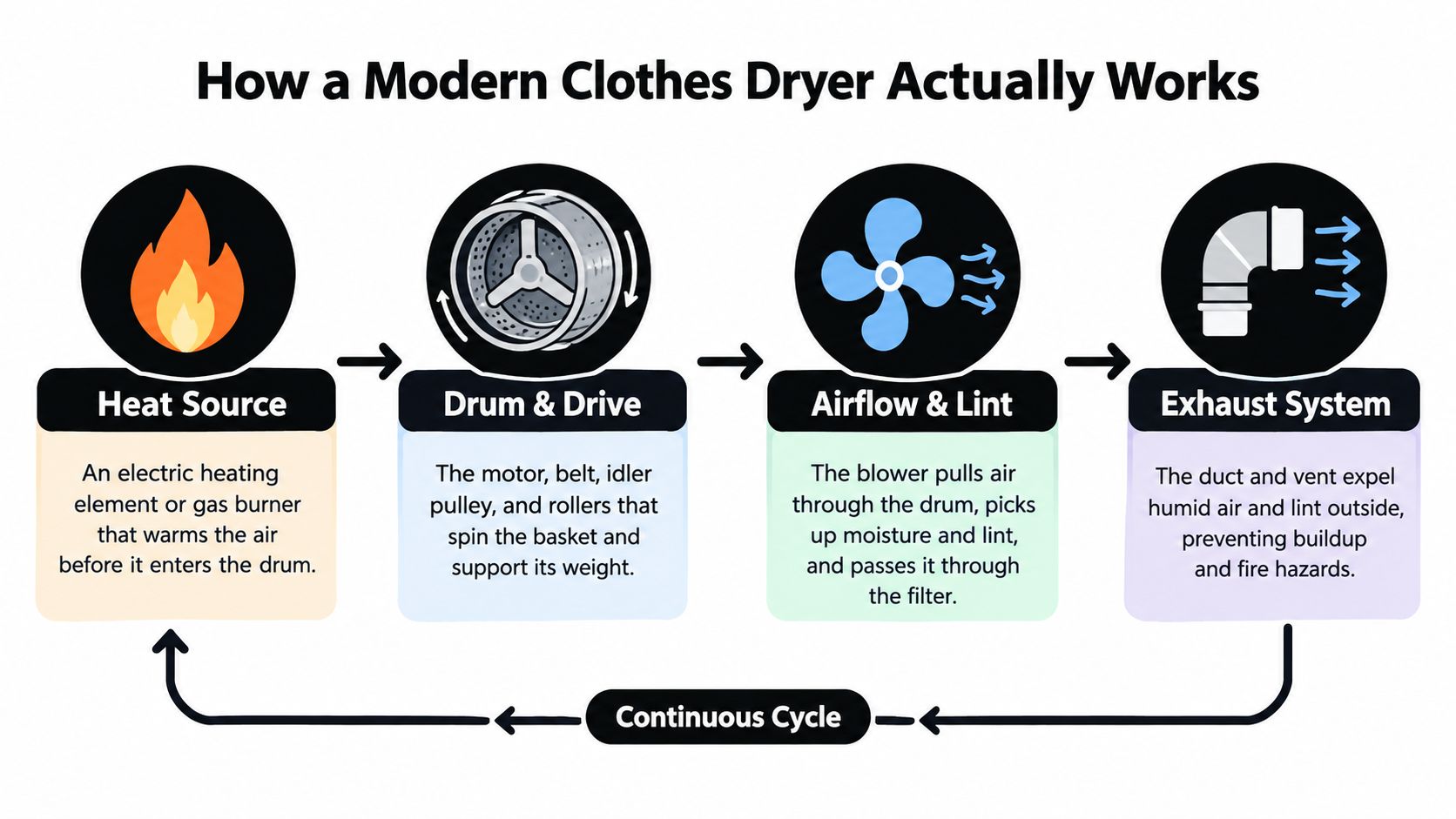
Drum and drive
The motor, belt, idler pulley, and rollers turn the drum and support the load. When this system fails, the dryer may hum, squeal, thump, or run without the drum moving.
If the belt snaps, the motor may still sound alive but the clothes won't tumble. If a roller wears out, you'll hear it before you see it. If the motor seizes, the machine may try to start and then stop.
Airflow and lint
This is the part homeowners ignore until they shouldn't. Air has to move through the lint screen, internal duct, transition hose, and outside vent cap. If it can't, the dryer can't get rid of moisture or excess heat.
Restricted airflow is a major failure path. Axis Appliance Repair's dryer overheating guide notes that clogged lint screens, crushed ducts, lint-filled vents, and blocked vent hoods reduce exhaust flow, raise internal temperature, and can trigger thermal cutoff or thermal fuse failures. That's why a good technician checks airflow before throwing expensive parts at the machine.
Heat source
Electric models use a heating element. Gas models use a burner assembly. Both rely on thermostats and safety devices to regulate temperature.
A no-heat complaint doesn't automatically mean the heater itself is bad. A dryer with poor venting can overheat and damage the heat circuit. A proper diagnosis checks the whole chain. Fix Appliance Fast's troubleshooting guide notes that a good electric heating element typically measures about 10 to 20 ohms, while a high-limit thermostat should show continuity near 0 ohms at room temperature.
Controls and sensors
The timer, selector knobs, moisture sensors, door switch, and main control board tell the dryer when to start, heat, cool, and stop. When this system fails, symptoms get weird. The dryer may stop early, refuse to start, run without heat, or behave inconsistently from one cycle to the next.
A technician isn't just “checking the dryer.” They're narrowing the problem to one of four systems, then proving the failure before replacing a part.
One more bit of context matters. The basic tumble-dryer design traces back to J. Ross Moore's design released to the American market in 1938, which is why modern repair still revolves around drum rotation, airflow, heat generation, and timed cycles. That history and the current repair economics are summarized in House Grail's overview of who invented the clothes dryer.
The Five Symptoms a Repair Tech Hears Every Week
When homeowners call, they usually describe the problem the same five ways. That's good news, because each symptom points to a short list of likely faults. The better you describe it, the faster a local tech can prepare for the visit.
No heat
The dryer runs, the drum turns, but the clothes come out cold or damp. This usually points to a power issue, failed heating element, blown thermal fuse, bad thermostat, or gas ignition problem.
What to say on the phone: “The drum spins, but there's no heat at all.”
Long dry times
If one load now takes two cycles, I look at restricted venting first, then blower problems, then sensor issues. Long dry times often have more to do with airflow than with the heating element itself.
What to say: “It heats some, but it's taking much longer than normal to dry a load.”
Drum won't spin
This complaint usually means broken belt, seized rollers, stuck idler pulley, or a failing motor. If you hear the machine trying to run but the drum doesn't move, that's useful information.
What to say: “It powers on and hums, but the drum isn't turning.”
Won't start at all
No sound, no action, nothing. Now I'm thinking door switch, start switch, control failure, power supply issue, or something in the safety circuit.
What to say: “I press start and get either silence or one brief click.”
Burning or musty smell
A musty smell can come from damp lint and poor venting. A burning smell is more urgent. That can point to lint buildup, a slipping belt, overheated motor, or restricted exhaust.
If you smell burning insulation, hot lint, or rubber, stop running the dryer until somebody diagnoses it.
Five Common Dryer Symptoms and Likely Faults
Symptom | Likely Fault | Typical Repair |
|---|---|---|
No heat | Heating element, thermostat, thermal fuse, gas ignition issue, partial power loss | Electrical diagnosis, part replacement, airflow check |
Long dry times | Clogged vent, lint buildup, weak blower, moisture sensor issue | Vent inspection, cleaning, blower or sensor service |
Drum won't spin | Broken belt, seized rollers, bad idler pulley, failing motor | Drive-system teardown and part replacement |
Won't start | Door switch, start switch, control board, safety circuit fault | Switch testing, board diagnosis, electrical repair |
Burning or musty smell | Lint buildup, slipping belt, motor overheating, poor exhaust | Shut down machine, inspect venting and internal components |
Here's the booking shortcut. Don't say, “It's broken.” Say exactly what the machine does, whether it heats, whether the drum spins, whether you smell anything, and whether the problem is constant or intermittent. That gets the call moving in the right direction.
Quick Checks You Can Safely Try Before Calling
Before you pay for a service call, do the simple checks that matter. Not fake internet “repairs.” Real checks that can rule out the obvious in under ten minutes.
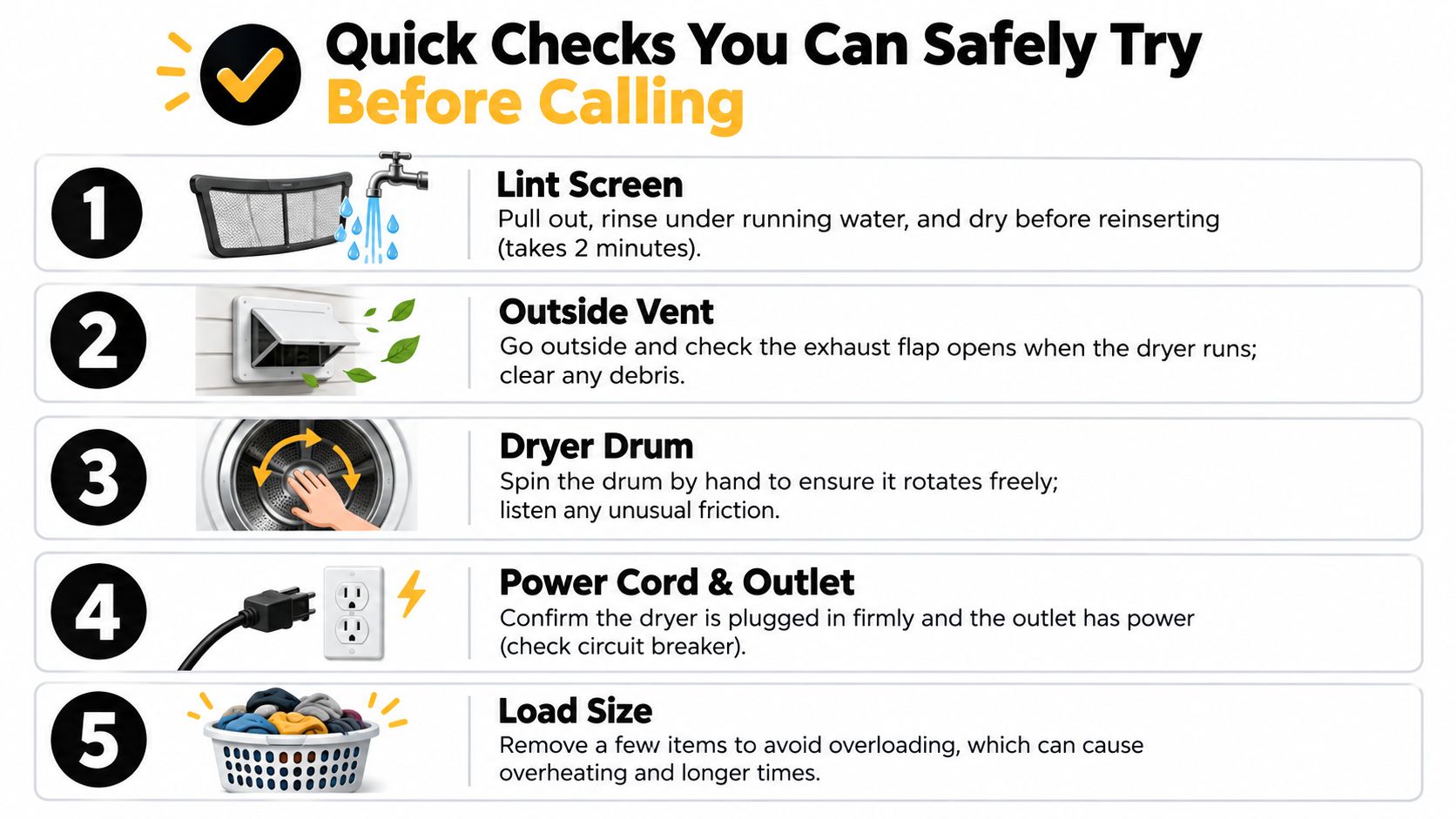
Start with the easy wins
Clean the lint screen properly Pull it out, remove lint, then rinse it under water. Dryer sheet residue can leave a film that slows airflow.
Check the outside vent flap Run the dryer and step outside. The flap should open freely and push air out. If it barely moves, airflow is restricted somewhere.
Confirm the cycle settings Make sure nobody set it to Air Fluff, no-heat, or wrinkle hold. This happens more than people want to admit.
After those checks, watch this quick visual guide before you do anything else around the machine:
Then do the safe listening checks
Press the door switch by hand Open the door and press the switch. It should click firmly. If it feels loose or dead, that's useful information for the tech.
Listen when you press start A hum suggests the motor is trying. Total silence often points toward power, switch, or control trouble.
Unplug before any visual check behind the dryer If you look at the cord, plug, or vent hose, disconnect power first. Don't reach around a live dryer.
Spin the drum by hand It should move with some resistance, not bind up like something is rubbing hard inside.
Stop sign: If you see a glowing heater housing where it shouldn't be glowing, smell burning, or find obvious scorching, quit troubleshooting and book service.
What clearly means call a pro
Call for service if any of these happen:
The dryer runs but still won't heat after cleaning the lint path and checking settings
The vent airflow is weak at the outside hood
The drum won't turn
You smell burning
The machine shuts off mid-cycle
You hear grinding, squealing, or heavy thumping
That's the point where “laundry dryer repair near me” stops being a search and becomes the right move.
Why Local Professional Repair Beats DIY
Once the problem moves past lint and settings, DIY usually costs more than people expect. Not because every dryer repair is huge, but because the mistakes are expensive.
The electrical risk is real
Electric dryers use 240-volt circuits plus sensitive controls. Probe the wrong terminal, short a board, or reconnect something wrong and you can turn a manageable repair into a much larger one. That's not me being dramatic. That's just how modern appliance electronics work.
The mechanical teardown isn't forgiving
Getting into a dryer means removing panels, releasing belt tension, handling the drum, and putting the drive system back exactly right. Misroute a belt, damage an idler, or reinstall a drum poorly and a simple repair turns into noise, repeat failure, or a machine that won't run at all.
Local techs save time because they arrive prepared
A decent local appliance tech usually carries common dryer parts like belts, thermal fuses, igniters, and door switches. That matters. You're not waiting on a guess, then waiting again on a part that should've been on the truck in the first place.
If you're comparing service options in St. Charles County, prioritize shops that also handle broader home repair realities. Sometimes the issue around the dryer matters too, including vent routing, closet access, trim removal, or utility-area fixes. In that case, a company with both appliance and handyman services can make practical sense.
The cheapest service call is the one that diagnoses it correctly the first time.
There's also the paperwork side. When a credentialed local company does the work, you've got a written record, labor coverage, and a clear line of responsibility if the problem returns. That beats guessing with online parts and hoping the symptom meant what you thought it meant.
Repair or Replace How to Decide
Homeowners either make a smart call or throw money the wrong direction. Don't use a lazy rule like “always repair” or “never repair old appliances.” Use three factors: age, quote, and overall condition.
Start with age and repair cost
Dryers last about 13 years on average, and repair cost matters a lot in that decision. Consumer Reports repair guidance cited in its dryer repair-or-replace article lists median electric-dryer repair costs of $118 for lower-priced units, $160 for midpriced units, and $188 for higher-priced units. That's why many dryers are worth fixing when the problem is isolated and the rest of the machine is sound.
My advice is simple. If the dryer is younger, the quote is reasonable compared with replacement, and the failure is a single part, repair it. If it's old, noisy, rusting, and now needs a motor or major internal work, replacement starts making more sense.
Repair vs Replace Decision Matrix
Factor | Repair Makes Sense | Replace Makes Sense |
|---|---|---|
Age | Newer unit with useful life left | Older unit near the end of service life |
Repair quote | Single-part repair well below replacement cost | Large repair that gets too close to replacement cost |
Condition | Clean cabinet, solid drum, no recurring issues | Multiple failures, rust, repeated breakdowns |
Performance | Normal drying before current fault | Rising energy use, chronic long cycles, weak overall performance |
Urgency | Fast fix needed for tenants or listing prep | Planned upgrade with time to shop and install |
The calls that are usually easy
Repair usually wins when the dryer has:
A bad belt
A failed door switch
A thermal fuse issue
A single heating problem
No history of repeat breakdowns
Replacement usually wins when you've got an aging unit with several issues stacked together.
For local property owners, urgency changes the math. Landlords between tenants and sellers getting a house photo-ready often need the machine running this week, not a long debate about perfection. If cash flow is the sticking point, look at repair financing options before assuming replacement is the only path.
What to Expect from a 1st Choice Home Repairs Visit
When you book a dryer repair visit, the process should be straightforward. No mystery. No surprise work. No technician taking half the machine apart before telling you what it costs.
How the visit usually goes
First, you book by phone or online and describe the symptom. That matters because “won't heat,” “won't spin,” and “burning smell” lead a tech to different likely parts and different first checks.
Then the technician arrives in the service window, introduces himself, and confirms the complaint before touching the machine. A proper visit starts with diagnosis, not random part swapping. You should get a clear written quote before repair work begins.
1st Choice Home Repairs Service Visit Overview
Step | What Happens | Timeframe |
|---|---|---|
Booking | Homeowner books by phone or online and describes the symptom | Before the visit |
Arrival | Technician arrives in the scheduled window and reviews the issue | Start of visit |
Diagnosis | Dryer is inspected for airflow, drive, heat, and control faults | During visit |
Quote | Written repair recommendation is provided before work starts | After diagnosis |
Repair | Common stocked parts may allow same-visit completion | Same visit when applicable |
Wrap-up | Completed work is confirmed and follow-up communication is sent | End of visit |
Coverage, parts, and practical details
For this local service area, the cities covered include St. Charles, O'Fallon, St. Peters, Wentzville, Lake Saint Louis, Dardenne Prairie, Chesterfield, Ballwin, Manchester, Ellisville, and Wildwood. For homeowners, that's the part that matters most. Can they get to your house this week, and can they finish the job without turning one service call into three?
A well-run visit also includes basics people notice right away. Shoe covers. Drop cloths when needed. A clean work area. A short explanation of what failed and what was replaced.
The warranty terms matter too. Here, the service framework includes 30 days on labor and 90 days on parts. Financing is also available through Wisetack for qualifying repair situations above the company's threshold, which helps when the repair is necessary now but wasn't in this month's budget.
Getting Your Dryer Back Without the Hassle
At this point, the path should be clear. If the problem is lint, settings, or a blocked outside flap, handle it now. If the dryer still won't heat, won't start, stops mid-cycle, or smells hot, stop guessing and book service.
The whole point of searching Laundry Dryer Repair Near Me is speed with judgment. You want someone local who can tell the difference between a quick save and a machine that isn't worth another dollar. That's what keeps a bad dryer from eating your week.
For homeowners in St. Charles County and nearby west St. Louis County communities, same-week scheduling matters because laundry doesn't pause. Damp clothes pile up fast. Tenant turnovers don't wait. Listing prep doesn't wait either.
What makes the process easier
You already know the symptom from the checklist above
You know when to stop DIY
You've got a repair-versus-replace filter instead of guessing
You can confirm the service area quickly before wasting time
If you're ready to move, use the contact page for local scheduling. Book the call, describe the exact symptom, and have the model number ready if you can reach it.
Don't keep running a dryer that's overheating, shutting down, or filling the laundry room with hot damp air. That's how a repair turns into a bigger home problem.
A good dryer repair call should end with one of two outcomes. Either the machine gets fixed with a clear explanation, or you get a firm answer that replacement is the smarter move. Both are useful. What isn't useful is letting wet laundry sit while you spend another night trying to diagnose a heat circuit from your phone.
1st Choice Home Repairs handles dryer problems the way they should be handled: clear diagnosis, straightforward repair recommendations, and practical help for homeowners in St. Charles County and nearby communities. If your dryer won't heat, won't spin, or keeps shutting down mid-cycle, visit 1st Choice Home Repairs and get it scheduled before the next load turns into another delay.
Comments