
Dryer Repair Near Me Fast Same Week Help You Can Trust

Laundry has a way of picking the worst possible moment to go sideways. You load a wet batch after dinner, hear the dryer tumbling like normal, come back an hour later, and the towels are still damp and heavy. Now you're wondering whether this is a simple fix, a vent problem, or the start of an expensive replacement.
That's usually what people mean when they search for dryer repair near me. They want someone local, yes, but they also want a quick answer to a bigger question. Is this just annoying, or is it unsafe?
A dryer that won't dry isn't always begging for a new part. A lot of the time, it's asking for better airflow, a vent inspection, or a safety check before anybody starts swapping components. That matters because a dryer is one of those appliances where poor performance and fire risk can overlap. The smartest first move is to treat it as an airflow and heat-management problem, then narrow down whether the root cause is lint buildup, blocked exhaust, a failed heating circuit, worn support parts, or age-related wear.
If you're in St. Charles, O'Fallon, Lake St. Louis, Chesterfield, Wildwood, St. Peters, Ballwin, or a nearby community, same-week help can make the difference between one missed laundry cycle and a week of disruption. Before you book, it helps to understand what your dryer is trying to tell you.
When Your Dryer Lets You Down Right Before Laundry Day
A lot of dryer problems begin with a sentence I've heard for years: “It still runs, but it's not drying.”
That detail matters. If the drum turns, the light comes on, and the timer moves, the machine isn't completely dead. It's working partway. That usually means the problem lives in one of three places: heat, airflow, or sensing. Homeowners often assume the heating element failed. Sometimes that's true. But just as often, the dryer is getting hot and still not drying because moist air can't leave the machine.
The busy-household version of the problem
Think about a normal week. School clothes need to be ready by morning. Work shirts are in the basket. Bedding is half done. Then the dryer starts stretching one load into two or three cycles. You're not just dealing with a bad appliance. You're dealing with time, humidity, and a laundry room that suddenly stops cooperating.
For landlords and property managers, the pattern looks different but leads to the same urgency. A tenant says the dryer “takes forever” or “smells hot.” That can sound minor until you realize slow drying often points to restricted venting. In a rental, that's not something to put off and “watch for a while.”
A dryer that tumbles but won't finish the job is usually giving clues early. Catching those clues is cheaper and safer than waiting for a hard failure.
What people usually get wrong first
Focusing on the symptom they can see, people assume there's “no heat” when clothes are wet. Sometimes there is heat, but not enough moving air. Sometimes the blower is pushing against a clogged exhaust path. Sometimes the sensor bars are coated with residue from dryer sheets, so the machine ends a cycle before the load is really dry.
Here's the practical takeaway:
If clothes are warm but damp, suspect airflow first.
If clothes are cold and damp, suspect a heating failure or power issue.
If the dryer shuts off mid-cycle, suspect overheating, airflow restriction, or a safety device in the heat circuit.
If you smell something hot or burnt, stop using it until someone checks it.
What a useful service call should answer
When you search for local dryer repair, you don't just need a technician with parts. You need someone who can answer a few plain questions without dancing around them.
What failed first: Was it the vent path, the heater circuit, a belt, rollers, or a control issue?
What's urgent: Is this an inconvenience, or should the dryer stay off until it's inspected?
What's worth paying for: Is the repair sensible, or are you throwing money at an aging machine with recurring problems?
What should change after the repair: Better ducting, better cleaning habits, or a full replacement plan?
Those answers are what turn a rushed service call into a lasting fix.
How Your Dryer Dries Clothes and Why Airflow Matters Most
A dryer dries clothes by doing two jobs at once. It adds heat, and it removes moisture. If either job slows down, drying time stretches out.
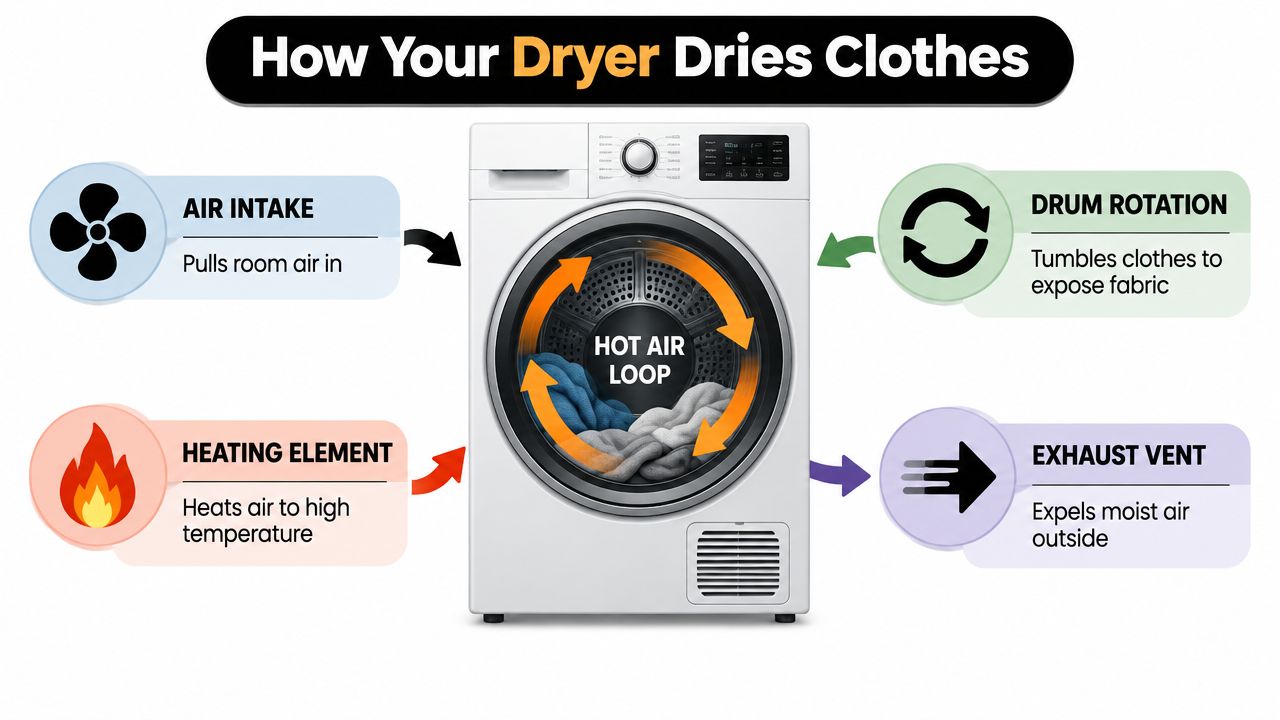
A simple way to picture it is a bathroom fan after a shower. Warm air helps, but the room only dries out once damp air leaves. Your dryer works the same way. The machine has to move moisture out of the drum and all the way outside the house.
The four parts that do the work
Inside the cabinet, four systems have to cooperate:
Air intake pulls room air into the dryer.
Heat source warms that air. Electric dryers use a heating element. Gas dryers use a burner assembly.
Drum movement keeps clothes tumbling so more fabric surface meets the warm air.
Exhaust system carries that moisture-laden air through the vent and out of the home.
When all four are doing their job, each load dries a little with every pass of warm air. When airflow gets pinched, the dryer starts recirculating damp heat. That is why a machine can feel hot and still leave towels wet.
This is also why dryer repair should start with fire prevention and airflow, then move to parts. A failed thermostat or element matters, but a restricted vent can make a healthy dryer run hotter, longer, and less safely.
Why the vent matters more than the lint screen suggests
The lint screen is only the first filter. Fine fibers still slip past it and collect in the blower housing, the short duct behind the dryer, and the vent run inside the wall or crawl space. Over time, that buildup narrows the path for air, the same way plaque narrows a pipe.
Once that path tightens up, three problems show up together. Moist air cannot leave fast enough. Heat stays trapped longer than it should. Lint sits in a warmer space than it was meant to.
That chain reaction is why slow drying is often an airflow decision before it becomes a parts decision.
Duct material changes how well the dryer can breathe
The vent line itself matters more than many homeowners expect. A short, properly installed metal duct gives air a cleaner path out. A crushed flex line, a long run with extra turns, or a sagging duct makes the blower work harder and leaves more heat behind.
That is one of the clearest repair-versus-maintenance dividing lines. If the dryer still tumbles and heats, but loads take too long, a technician should inspect the full exhaust path before swapping parts. Sometimes the best fix is not inside the dryer at all.
Practical rule: If the dryer makes heat but clothes stay damp, treat the vent path as a likely cause before treating the machine like a collection of bad parts.
Where confusion starts with electric and gas dryers
Electric and gas models use different heat sources, but the drying process is still the same. Both need steady airflow, drum motion, and a clear exit path for moisture.
That overlap is what makes dryer symptoms tricky:
Warm, damp clothes often point to restricted airflow on either type of dryer.
No heat at all can come from an electric element problem, a gas ignition problem, or a safety device that opened after overheating.
Cycles that end too soon can trace back to moisture sensors, control issues, or poor airflow that confuses the drying cycle.
If you want a broader look at washer and dryer help in one place, the laundry appliance service page is a useful starting point.
One last point helps homeowners make better service decisions. If a dryer is older, has repeated heating complaints, and also has poor venting, fixing airflow first gives you a clearer picture of whether a part repair is still worth paying for. That saves guesswork, and it gives the technician a better starting point when they arrive.
Warning Signs Your Dryer Needs Professional Attention Now
Some dryer symptoms are mostly inconvenient. Others are your warning to stop the cycle, unplug the machine if it's safe to do so, and arrange an inspection. Knowing the difference keeps a nuisance from turning into a hazard.
To put the safety side in perspective, the National Fire Protection Association estimates that U.S. fire departments responded to an average of 15,970 home structure fires involving clothes dryers or washing machines each year during 2010 to 2014, with 92% involving clothes dryers. Those incidents caused annual averages of 13 civilian deaths, 444 injuries, and $238 million in direct property damage. The same report says the leading first-ignited materials were dust, fiber, or lint and clothing at 26% each, according to the NFPA report on home fires involving clothes dryers and washing machines.
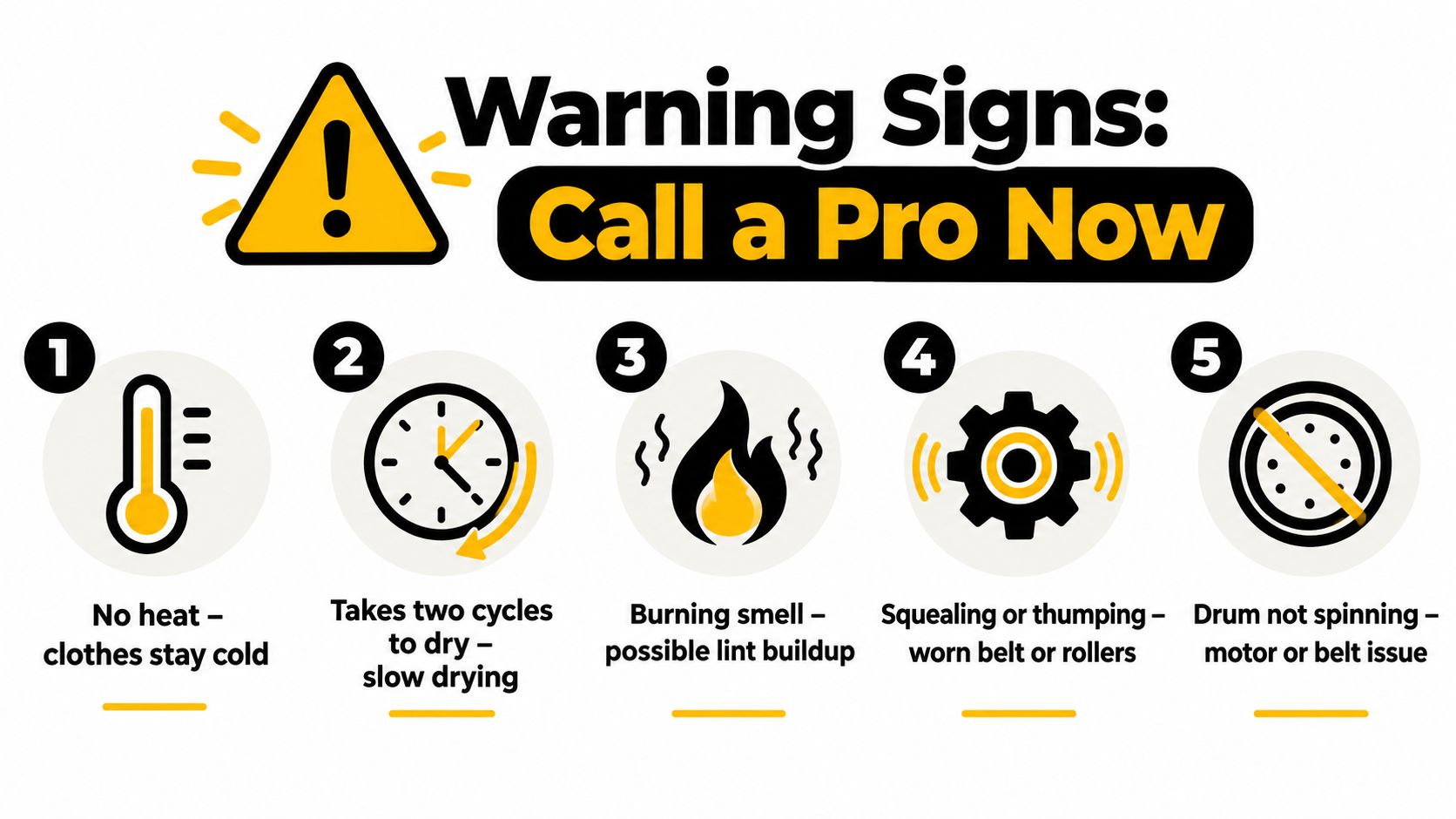
Lint and trapped heat are a bad combination. When slow drying turns into overheating, the machine stops being just a laundry problem.
Signs you should stop using it and call now
A few symptoms move the dryer into the “don't keep testing it” category.
Burning smell: This can mean lint buildup near the heater, blower, or exhaust path. It can also mean a belt or motor issue overheating under load.
Very weak airflow outside: If the exterior hood barely moves air while the dryer runs, moisture and heat may be trapped inside the system.
Shutting off mid-cycle: Dryers often do this when they overheat and a safety control interrupts the heating circuit.
Scorching hot cabinet or laundry room: Excess heat where it shouldn't be usually points back to restricted airflow or vent trouble.
These are the calls that deserve urgency, especially in homes with kids, in older properties, and in rentals where vent history may be unclear.
Signs that still matter even if there's no smell
Other symptoms might not feel dramatic, but they still need a proper diagnosis.
No heat but the drum turns
When the drum spins and the timer runs, many people assume the dryer “mostly works.” In reality, a failed heating element, thermal cut-off, thermostat in the safety chain, or a power issue can leave the dryer tumbling cold.
Takes two cycles to dry
This is one of the most common complaints, and it often points to airflow first. The dryer may be producing heat just fine, but if moist air can't escape, the load stays damp no matter how long you run it.
Squealing, scraping, or thumping
Those sounds usually come from support parts such as rollers, idler pulleys, glides, or the belt path. That's less about fire risk and more about preventing a small mechanical wear issue from turning into a larger breakdown.
A quick visual summary helps if you're sorting symptoms before making the call.
A simple urgency filter
Use this when you're deciding whether to keep using the dryer until an appointment.
Symptom | Safer to schedule soon | Better to stop using now |
|---|---|---|
Load needs extra time | Yes, if there's no smell or excess heat | No, if the cabinet gets unusually hot |
No heat | Yes, if it runs normally otherwise | Stop if it trips breakers or smells burnt |
Squeal or thump | Yes, for most wear-part noises | Stop if sound is harsh, sudden, or smells hot |
Drum won't spin | No | Yes |
Burning smell | No | Yes |
Weak exterior airflow | No | Yes |
Why prompt inspection matters for owners and managers
A homeowner can usually notice a pattern because they live with the machine. In rentals or managed properties, complaints often arrive after several cycles have already been wasted. That delay is exactly why weak airflow and recurring damp loads deserve a closer look. The issue may not be a failed part at all. It may be a vent path that nobody has evaluated in a long time.
Repair or Replace and What Dryer Repair Typically Costs
After the safety question, this is the next one people ask. Is this dryer worth fixing?
Broad consumer cost data shows that professional dryer repairs commonly range from about $100 to $430, with an average around $180, based on HomeAdvisor's dryer repair cost overview. That's useful context, but it doesn't answer the ownership question by itself. A fair repair quote can still be a poor choice if the machine has a history of repeat failures or if the cause is neglected airflow that will keep triggering trouble.
When repair usually makes sense
A dryer is often worth repairing when the problem is focused and the rest of the machine is in decent shape. Good examples include a single failed support component, a heating element issue with an otherwise solid cabinet and drum system, or a vent-related performance problem that can be corrected.
Repair also makes sense when the complaint is recent and specific. “It suddenly stopped heating last night” is different from “it has smelled hot, needed extra cycles, and squealed on and off for months.”
When replacement deserves a serious look
Replacement starts making more sense when you're stacking problems. Maybe the venting has been poor for a long time, the machine has recurring heat-related shutdowns, the drum supports are worn, and parts availability is getting sketchy. At that point, even a low initial quote can hide a more expensive story.
The other replacement clue is confidence. If no repair will leave you feeling safe using the dryer normally again, that matters. Peace of mind is part of the value calculation.
The cheapest repair quote isn't always the lowest-cost outcome. A dryer with unresolved airflow trouble can come back with the same complaint in a different costume.
Should you repair or replace your dryer
Scenario | Repair Makes Sense | Consider Replacement |
|---|---|---|
Single clear failure, such as no heat with otherwise normal operation | Yes, especially if diagnosis points to one repairable component or a correctable vent issue | Less likely |
Clothes take too long to dry, but the root problem is restricted venting | Yes, if airflow correction solves the problem and the dryer itself is sound | Consider replacing if the machine also has multiple unrelated wear issues |
Repeated service history for heat or shutdown problems | Sometimes, if one overlooked root cause explains the repeats | Yes, if failures keep returning after proper repair |
Worn mechanical parts plus heating problems | Depends on overall condition and parts availability | Stronger case for replacement |
Poor dryer performance in an older unit with uncertain vent history | Repair may still be reasonable if inspection shows the appliance is otherwise stable | Consider replacement if the estimate starts to feel like catch-up maintenance |
A practical way to think about the money
Don't compare repair cost to replacement cost in a vacuum. Compare the likely result.
Ask questions like these:
Will this repair restore normal drying, or is it a partial fix?
Was the failed part the true cause, or a victim of overheating and poor airflow?
If I approve this repair, what's the chance I'm calling again soon for a related issue?
Would a vent correction solve more than a parts swap would?
That last question gets overlooked all the time. A lot of local pages talk about parts because parts are easy to name. Ownership decisions are harder. But if the machine's main problem is how air leaves the house, solving only the symptom can waste money.
One straightforward local option for diagnosis and repair is 1st Choice Home Repairs, which handles washer and dryer service in the communities described later in this guide.
What Happens During a Professional Dryer Repair Visit
The best repair visits follow a simple order. A dryer that will not heat, shuts off, or takes too long to dry can point to several different faults, but a careful technician does not start by guessing which part to swap. The visit usually starts with one bigger question. Is the dryer failing because it cannot move air safely, or because a component inside the machine has failed?
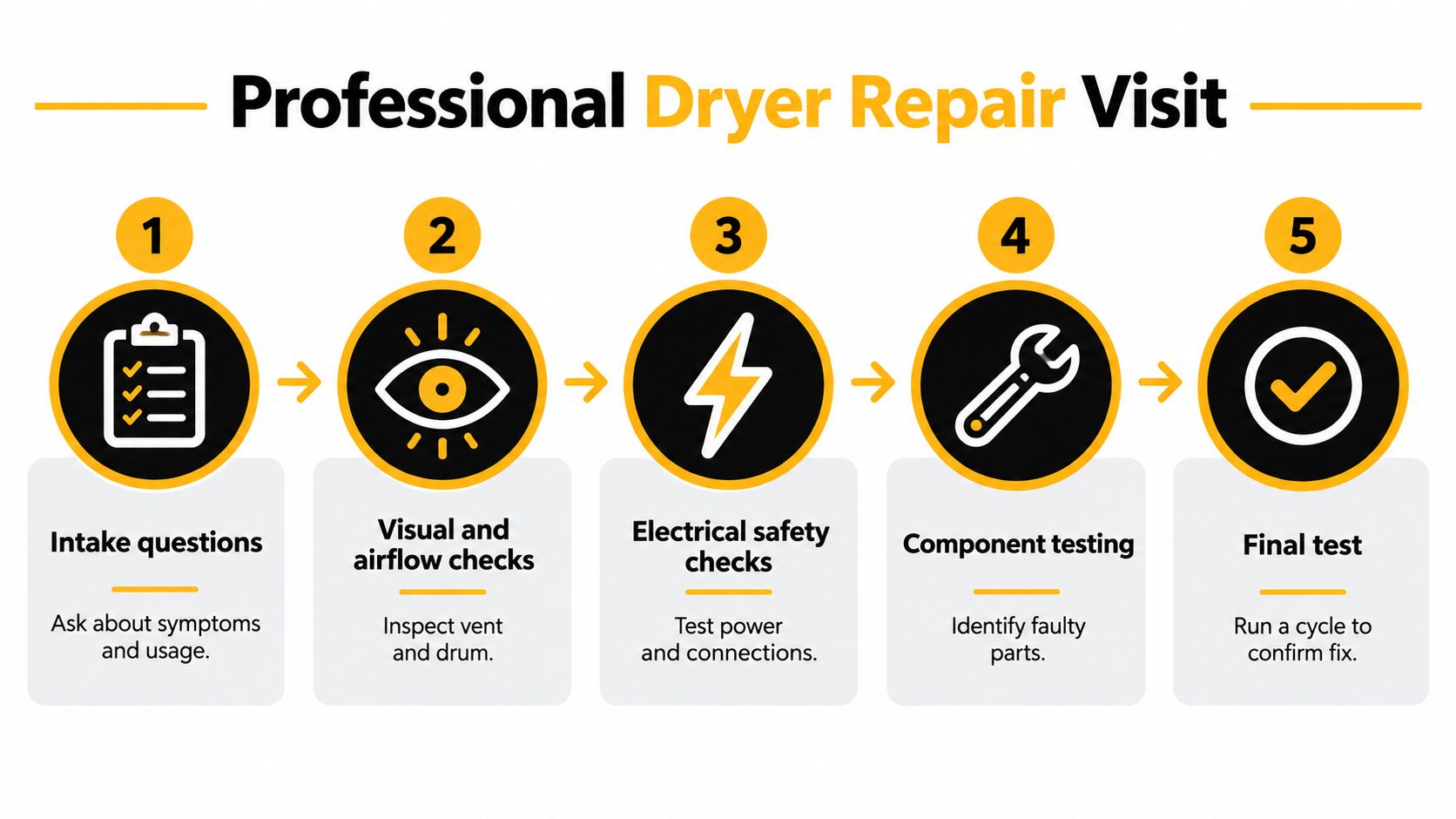
The questions that shape the diagnosis
A seasoned tech often learns a lot before removing a single panel.
They will usually ask when the problem started, whether the drum still turns, whether clothes come out warm or stay cool, whether the issue happens on every cycle, and whether you noticed a hot smell, scraping noise, or sudden shutdown. Those details matter because dryers fail in patterns. A dryer that tumbles with no heat usually points toward the heat circuit or power supply. A dryer that gets hot but leaves clothes damp often points back to airflow. A dryer that squeals at startup may have support parts wearing out before anything electrical fails.
That order matters for safety and for your wallet. Replacing a thermostat in a dryer with a badly restricted vent can solve the symptom for a while and miss the reason the part overheated in the first place.
The first checks usually focus on airflow and basic safety
Before deeper testing, a good technician often inspects the easy-to-miss basics that change how the whole machine behaves:
Lint screen condition: heavy buildup can suggest poor maintenance or airflow trouble
Exterior vent discharge: weak airflow at the outside termination can signal restriction somewhere in the vent path
Power connection: electric dryers can tumble normally and still lose heat if the supply problem affects only part of the circuit
Drum movement: extra drag, rough rotation, or thumping can point to worn rollers, glides, or idler parts
This part of the visit is less glamorous than electrical testing, but it often explains more. A dryer is a little like a hair dryer attached to a vacuum route. If the hot air cannot leave, heat builds up where it should not, safety parts cycle harder than they should, and drying times stretch out.
When the technician starts testing components
If airflow and supply conditions look reasonable, the diagnosis usually moves inside the machine.
For no-heat complaints on electric dryers, technicians commonly test the heater circuit with a meter. Sears Home Services explains that a working heating element is often in the roughly 9 to 15 Ω range, and readings through related safety parts can help narrow the fault to the element, thermostat, or thermal cut-off rather than unrelated moving parts, according to Sears Home Services' guide to dryers that won't heat.
That kind of testing protects you from random part replacement. If the reading is open, the technician can explain what failed and why that specific part is being recommended. If the readings look normal, the problem may be elsewhere, such as wiring, controls, motor behavior, or a vent condition that changes how the dryer heats under load.
A useful repair visit separates a parts failure from an airflow failure. Sometimes the dryer needs both addressed. If only one gets fixed, the problem can come back.
What a clear closeout should include
By the end of the appointment, you should understand more than the name of a bad part. You should know what caused the symptom, whether there is any fire-risk concern tied to venting or overheating, and whether the proposed repair is likely to restore normal operation.
A solid service visit usually includes:
A plain explanation of the root cause
A written or verbal estimate before major parts are installed
A note about vent correction if airflow contributed to the failure
A test run after reassembly
A short explanation of what to watch after the repair
That last part matters. Good appliance service should leave you with fewer surprises, not just a spinning drum and a receipt.
How to Prepare for Service and Book 1st Choice Home Repairs
A little prep can shave confusion off the visit and help the technician get to the root cause faster. For dryer repair near me, proximity is usually the main thing considered. It helps, but preparation matters just as much. A clear path to the appliance, a model number, and a good symptom description can turn a slow appointment into a productive one.
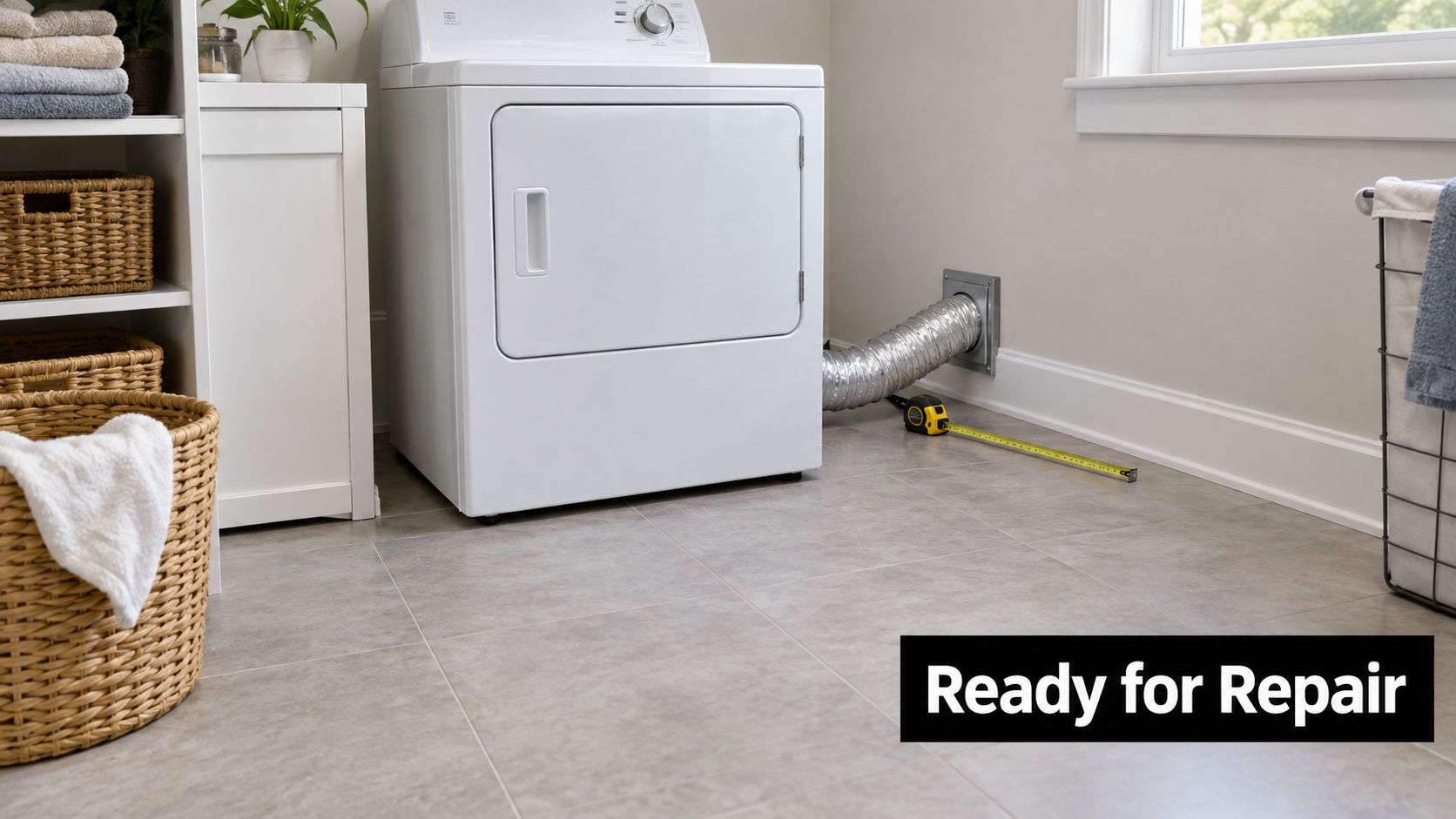
A simple checklist before the appointment
You don't need to take the dryer apart. Just make it easier to inspect safely and quickly.
Clear access around the machine: Move baskets, detergent bins, and anything stacked beside or on top of the dryer.
Write down the model information: A photo of the model tag works fine if the tag is hard to read.
Describe the symptom plainly: “Tumbles but no heat,” “takes two cycles,” “burning smell,” or “shuts off after ten minutes” is more useful than “not working right.”
Check the lint screen: Clean it so the technician can judge current airflow conditions more accurately.
Look for error codes or unusual lights: If the panel flashes anything, take a picture.
Secure pets and kids away from the work area: Repair visits move more smoothly when the laundry space stays clear.
What to gather if you're deciding between repair and replacement
If you're on the fence, have this information ready before the visit:
Recent history: Has this dryer needed service before?
Performance pattern: Sudden failure or gradual slowdown?
Vent history: Has the vent path ever been cleaned or corrected?
Your goal: Fast fix, safest fix, or best long-term value?
That last point helps more than people think. Some homeowners want to keep a familiar machine going if the fix is sensible. Others would rather avoid repeat visits and use the appointment to make a replace-or-repair call with confidence.
Local service areas and what to expect after booking
1st Choice Home Repairs serves St. Charles, O'Fallon, Lake St. Louis, Chesterfield, Wildwood, St. Peters, Ballwin, and nearby communities. The company brings 25 years of hands-on experience across appliance repair and home services, with same-week availability, fair upfront pricing, and financing options for households that need flexibility.
When you're ready to reach out, use the 1st Choice Home Repairs contact page to start the conversation. After booking, expect a normal intake process that asks about the symptom, your location, and scheduling needs. If your dryer has a hot smell, repeated shutdowns, or very weak vent discharge, say that early so the visit can be prioritized appropriately.
A prepared homeowner helps the technician do better work. The problem gets identified faster, the estimate is clearer, and the odds of a one-visit solution usually improve.
Get Your Laundry Back on Track With Local Experts You Trust
A dryer problem feels small until it interrupts the whole house. Then every wet load becomes a scheduling problem, and every strange smell or extra cycle raises a different concern. The useful way to think about it isn't “Which part failed first?” It's “Is this dryer moving heat and air safely, and if not, why not?”
That airflow-first mindset saves people from two common mistakes. One is ignoring a restricted vent because the dryer still runs. The other is paying for parts when the main trouble is poor exhaust flow, trapped heat, or a machine that's reached the point where replacement deserves a real conversation.
Local service matters because dryers rarely fail on a convenient day. Homeowners, landlords, and property managers usually need help that arrives quickly, diagnoses clearly, and explains the difference between an urgent safety issue and a repair that can be scheduled without panic. The right visit should leave you with more than a working drum. It should leave you with a dryer you understand better.
If you're weighing options, keep the decision simple. Notice the symptom. Stop using the machine if there's burning odor, unusual heat, or weak vent discharge. Prepare the basics before the appointment. Then choose a provider who can inspect the whole drying system, not just swap the most obvious part.
For households that want one place to handle appliance issues alongside broader home needs, the full list of repair and home services shows the range of work available. That matters when a dryer issue connects to venting access, laundry-room adjustments, or other practical fixes around the home.
A solid dryer repair isn't just about getting warm clothes again. It's about restoring a machine that dries efficiently, runs safely, and doesn't leave you wondering whether the next load will finish.
If your dryer is running long, not heating, or showing signs of airflow trouble, 1st Choice Home Repairs offers same-week help in St. Charles, O'Fallon, Lake St. Louis, Chesterfield, Wildwood, St. Peters, Ballwin, and nearby areas, along with fair upfront pricing and financing options when needed. For a local inspection that treats dryer trouble as a safety and performance issue, visit 1st Choice Home Repairs.
Comments