
My Outlet Is Not Working: A Quick Fix Guide

The coffee maker worked yesterday, but this morning it sits cold and silent. Your phone charger shows no light, the hair dryer won't start, and the rest of the kitchen appears perfectly normal. For “my outlet is not working,” start with the small checks below, but don't assume a dead receptacle is always a simple reset.
A failed outlet can result from a tripped GFCI, a breaker that stopped halfway, a worn receptacle, or a loose connection behind the wall. It can also signal heat, arcing, or wiring damage. The practical decision is straightforward: determine whether you're looking at a 60-second reset, a careful DIY repair, or a put-the-screwdriver-down situation.
Why a Dead Outlet Is More Than an Annoyance
A dead receptacle can be harmless. A hair dryer may have tripped a GFCI in the bathroom, which then shut off another outlet elsewhere. A breaker may have tripped without looking fully off. In those cases, the outlet itself may be perfectly sound.
The harder cases hide behind the faceplate. A loose terminal, a failed push-in connection, or a worn receptacle can interrupt power while neighboring outlets continue working. A plug that fits loosely, power that flickers when the cord moves, or a faint buzz suggests the connection may be heating or arcing rather than sitting idle.
The U.S. Consumer Product Safety Commission's electrical receptacle safety document estimates that receptacle outlets are involved in about 5,300 fires each year, causing 40 deaths and 110 injuries, along with approximately 3,900 emergency-room-treated injuries annually. Those figures don't mean every dead outlet is an emergency. They do show why warmth, scorching, buzzing, and loose-fitting plugs deserve prompt attention.
What the symptom can mean
Think of the outage as a clue, not a diagnosis.
One outlet is dead, nearby outlets work: A failed receptacle or loose connection is possible.
Several outlets are dead: Look for an upstream GFCI or tripped breaker before touching wiring.
The outlet works intermittently: Treat that as a connection warning, especially if moving the plug changes the power.
The faceplate is warm, marked, or smells burned: Stop troubleshooting and arrange professional inspection.
The breaker or GFCI trips again: Don't keep resetting it. Repeated trips point to a fault that needs diagnosis.
Electrical problems also contribute substantially to residential fire risk. A fire safety summary from Fort Worth's fire department describes faulty fixed wiring and receptacle problems as important ignition pathways. A nonworking outlet can therefore be a local defect, or the visible symptom of a larger branch-circuit problem.
Practical rule: A reset is reasonable when there are no warning signs. Heat, odor, discoloration, crackling, moisture, or repeated tripping changes the decision immediately.
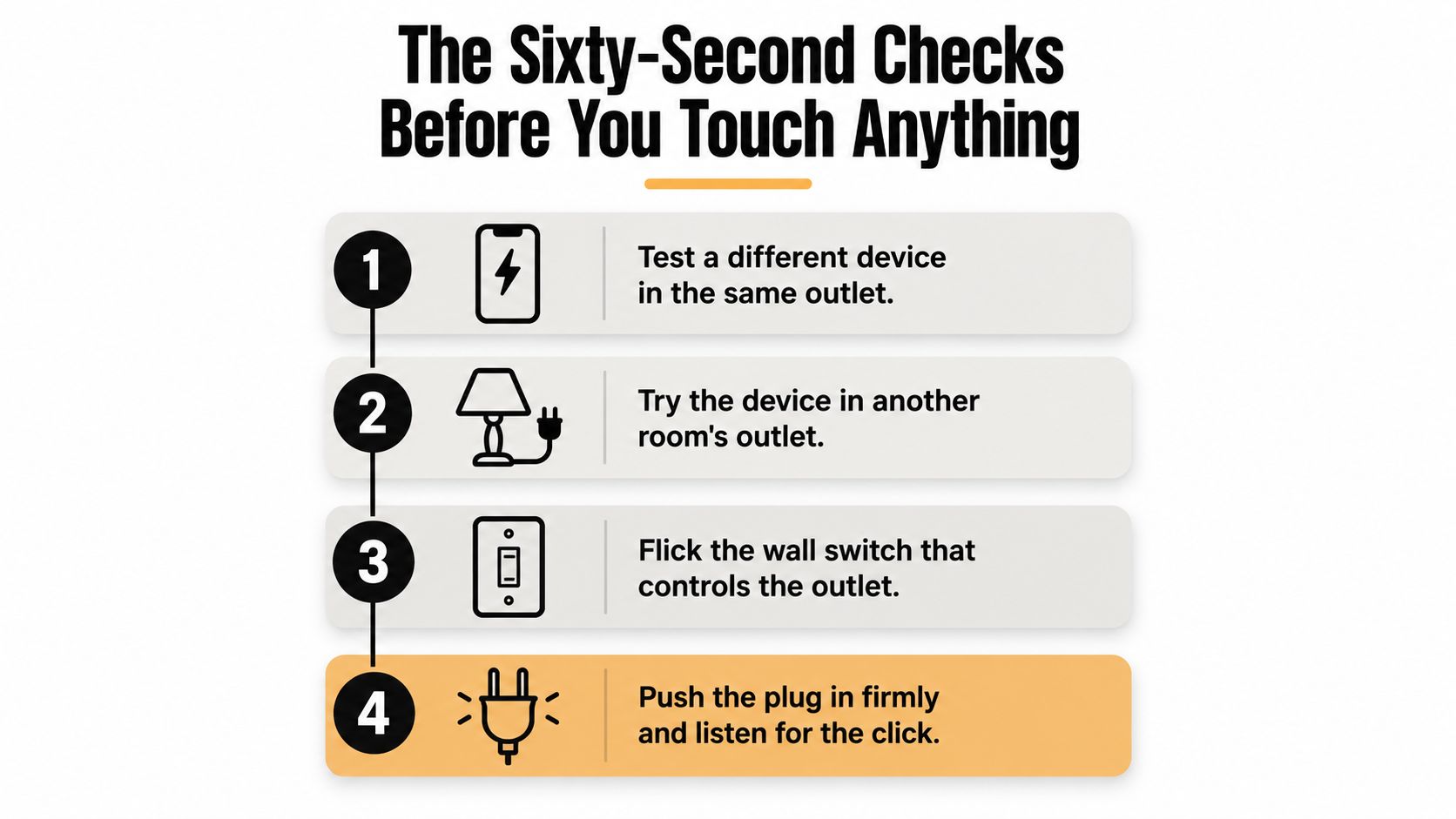
The Sixty-Second Checks Before You Touch Anything
Start without opening the outlet box or breaker panel. Each check should answer one question and narrow the fault.
Test the device somewhere known to work. Plug the coffee maker, lamp, or charger into a different outlet. If it fails there too, the appliance or charger is the problem. If the device works elsewhere, return it to the suspect outlet for the next check.
Try a different device in the dead outlet. A phone charger brick can fail without any warning, while a table lamp gives you a clearer visual result. Don't use a device with a damaged cord for testing.
Check neighboring receptacles. Test outlets on both sides of the room, then look in nearby hallways, bathrooms, the garage, basement, kitchen, laundry area, and outside. One GFCI can protect standard outlets downstream, so the controlling reset button may not be in the same room.
Look and listen before pressing anything. Note a popped GFCI button, a loose plug, warmth, buzzing, a scorch mark, or a burning smell. Those observations matter more than the outlet's appearance alone.
Decide what your observations mean
If another device works and no warning sign appears, a GFCI reset is the sensible next move. If multiple outlets are out, include the breaker panel in your check. If you find heat, damage, water, or a persistent odor, don't proceed to either reset repeatedly or remove the faceplate.
Write down which room is affected and which outlets still work. Mark every GFCI you find, including ones in the garage and outside. That simple map prevents the common mistake of assuming the closest outlet controls the circuit.
For more general home-repair reading, the home maintenance resources from 1st Choice Home Repairs can help you organize other household fixes, but electrical warning signs still call for restraint.
Resetting a GFCI the Right Way
A GFCI protects people by shutting off power when it detects current leaving the intended path. The dead outlet may be a standard receptacle with no buttons at all, while a GFCI upstream controls it. Check the kitchen, bathroom, laundry area, garage, basement, and exterior receptacles in a deliberate order.
Unplug appliances from the affected circuit first. A wet outdoor cord, damaged tool, or faulty appliance can cause the GFCI to trip again as soon as power returns.
Use one controlled reset
Find the closest GFCI that may feed the dead receptacle. Press its TEST button and confirm that the reset mechanism releases. Then press RESET firmly until it clicks and stays latched. Don't hammer the button repeatedly. The National Fire Protection Association's guidance on checking GFCI protection supports testing and resetting GFCI devices as part of maintaining household safety.
Once the button stays in, test the original outlet with a plug-in lamp or outlet tester. Then check the other outlets you identified as downstream. A successful reset restores power consistently, and the GFCI remains set with nothing connected.
If the first GFCI doesn't control the outlet, repeat the search at another nearby device. Older wiring arrangements can place the protective device in an unexpected location, so check methodically rather than assuming it must be beside the dead receptacle.
Know when the reset failed
A GFCI that won't latch, trips immediately when you connect an appliance, or trips again after a short period isn't asking for more button presses. The cause may be moisture, a damaged receptacle, a faulty appliance, a ground fault, or a downstream wiring problem.
Leave the suspect appliance unplugged and stop resetting the device. If the receptacle is wet, don't dry it with a hair dryer or use it while moisture is present. A professional can separate an appliance fault from a wiring fault without turning a small problem into an energized one.
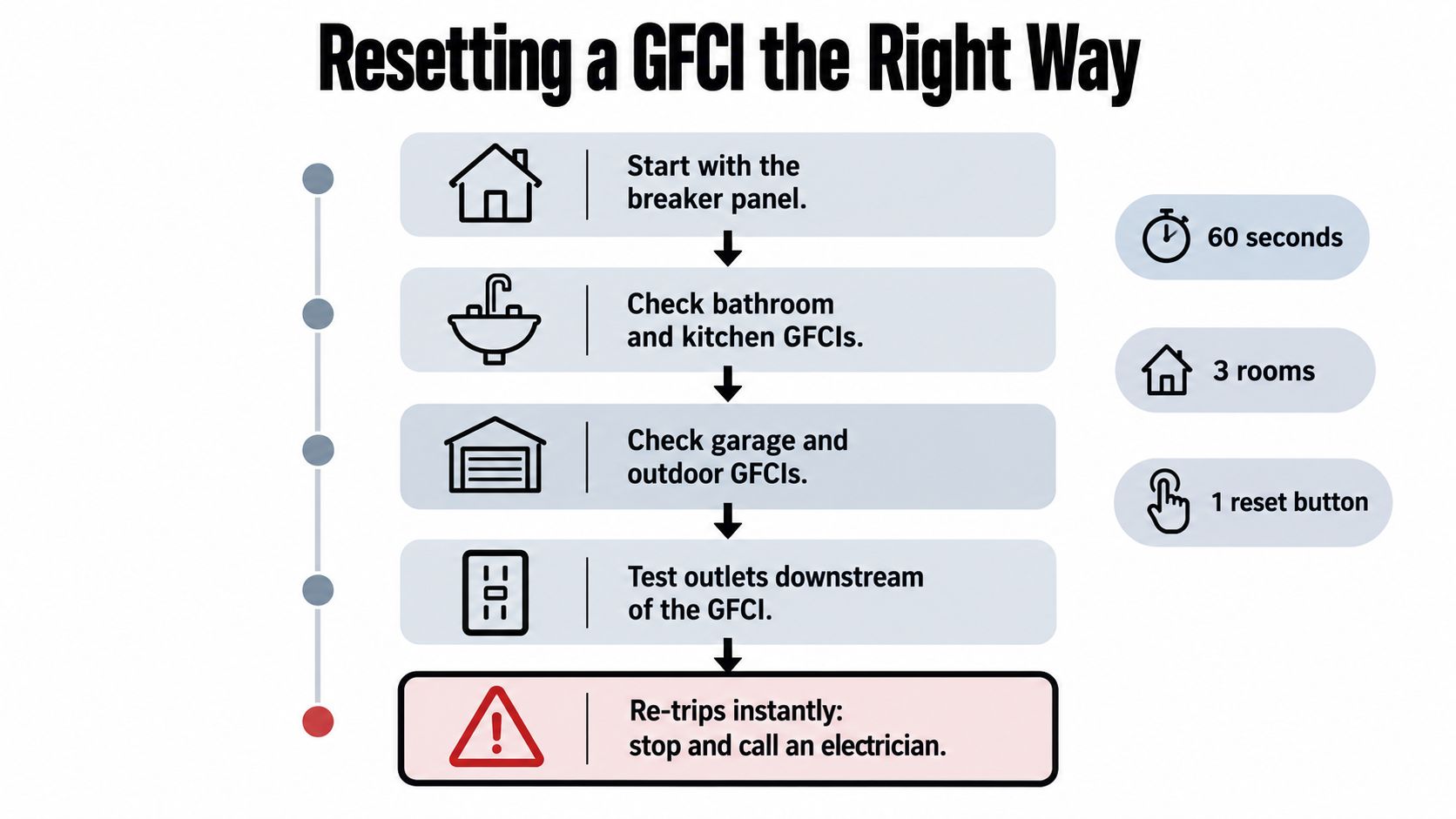
If the GFCI re-trips with the load removed, treat that as a diagnosis, not an inconvenience.
Checking the Breaker Panel and AFCI Protection
If the GFCI checks don't restore power, inspect the breaker panel from the outside. Find the circuit label for the affected room and look at the handle position. A tripped breaker may sit fully off, or it may rest between on and off and look almost normal at a quick glance.
Don't reach behind the panel cover or remove any dead-front screws. Keep your hands on the breaker handles only, with dry footing and clear visibility.
Reset a breaker once
For the suspected circuit, move the handle firmly to OFF first. Then move it firmly back to ON. This full cycle matters because nudging a half-tripped handle toward on may not reset the internal mechanism.
Test the outlet again. If the breaker immediately trips, leave it off. The trip may involve an overloaded circuit, a damaged appliance, a short, or a wiring fault. Repeatedly forcing it on removes a safety response that is protecting the circuit.
Recognize AFCI behavior
Some circuits use an AFCI breaker, which has a small TEST button and protects against certain arc-fault conditions. These breakers may respond differently from a standard thermal-magnetic breaker, and a reset usually requires moving the handle fully off before returning it to on.
Unplug recent additions such as a vacuum cleaner, power tool, or device with a damaged cord before attempting one reset. If the AFCI trips again, don't treat the result as a nuisance. The cord, appliance, receptacle, or circuit may need testing.
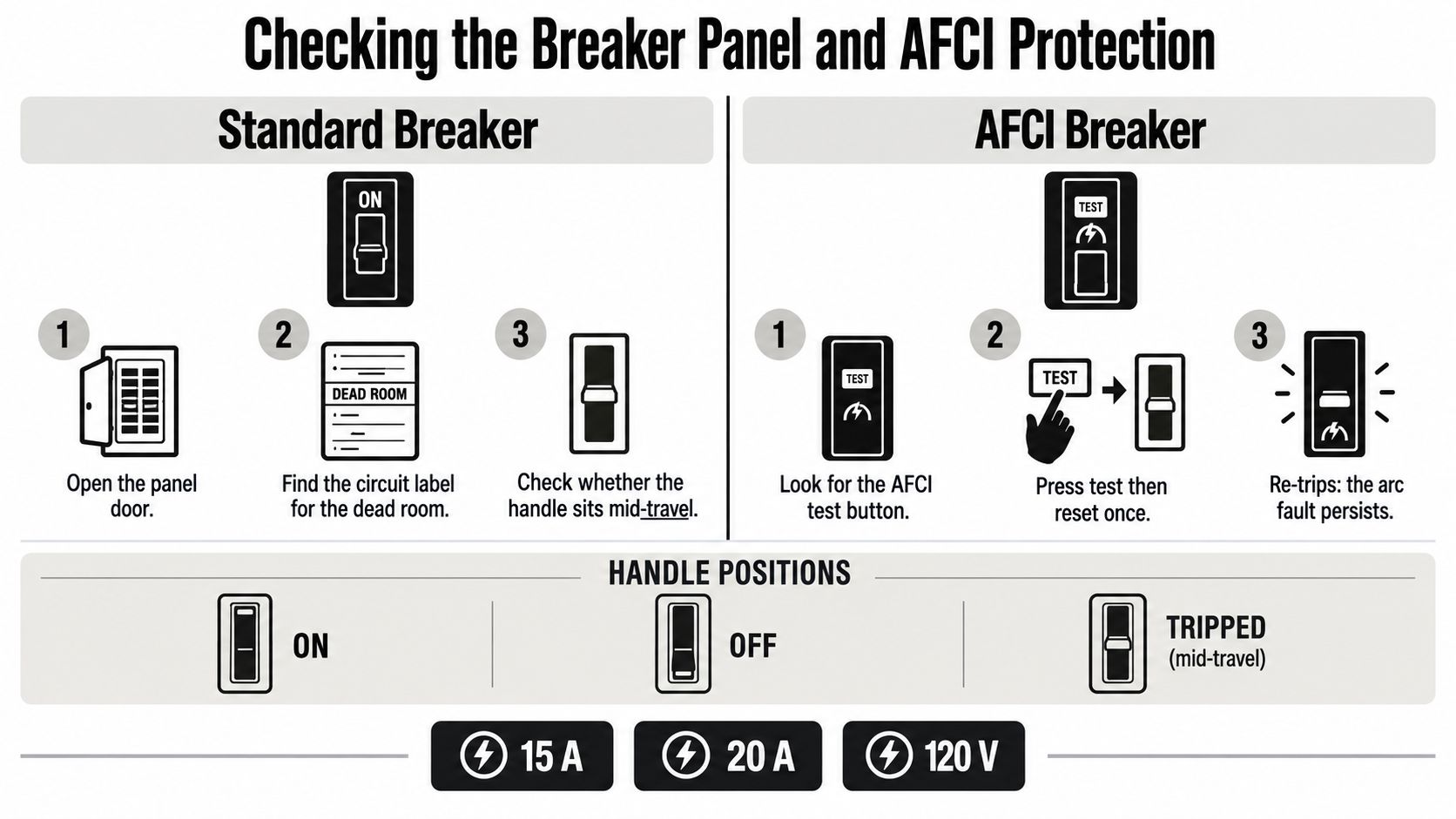
Panel inspection and a single reset are reasonable homeowner checks. Replacing a breaker, working inside the panel, moving circuit conductors, or diagnosing repeated trips belongs to a licensed electrician. A panel can contain energized parts even when one branch breaker is off.
Reading the Outlet With a Tester or Multimeter
A plug-in outlet tester is useful because it narrows the problem without asking you to remove the receptacle. A common three-light tester compares the hot, neutral, and ground relationships and displays a pattern. Read the label printed on your particular tester, since light layouts vary by manufacturer.
Light Pattern | Likely Problem | Likely Cause |
|---|---|---|
Two indicator lights show the correct pattern | Wiring appears correct at the tester | The outlet has the expected relationships, but this doesn't prove the connection can carry a load |
No lights | No usable power or an open connection | Tripped breaker, upstream GFCI, open hot, or another supply-side fault |
Open-ground indication | Ground path is missing or interrupted | Loose or broken ground conductor |
Open-neutral indication | Neutral connection is interrupted | Loose splice, failed terminal, or open neutral |
Hot and neutral reversed indication | Conductors are connected to the wrong terminals | Miswired receptacle or altered wiring |
Hot and ground reversed indication | Dangerous wiring relationship | Misidentified or misconnected conductors |
The tester can identify a pattern, but it doesn't repair the fault. A correct-looking result also doesn't rule out a loose connection that fails under load. Keep the tester in the face of the receptacle only. Never push probes into the wire side of the box.
What a multimeter adds
Set a multimeter to AC volts and use insulated probes. With power present and your hands clear, measure between the hot slot and ground, then between the hot slot and neutral. The electrical troubleshooting guide covering outlet voltage tests identifies approximately 115 to 125 volts as the expected hot-to-ground range, with hot-to-neutral closely matching it.
A hot-to-ground reading near 120 volts combined with a hot-to-neutral reading near 0 volts points toward an open neutral. An abnormal hot-to-ground result points farther upstream or toward a supply problem. A neutral-to-ground check and a continuity test with the breaker off can help distinguish a loose splice, failed pass-through, or receptacle defect.
A non-contact voltage pen is not enough to make this diagnosis. It can indicate the presence of voltage without telling you whether the neutral is intact or whether the connection has high resistance. If the readings are unusual, the GFCI or breaker re-trips, or you aren't comfortable holding the probes, stop and call a professional.
Simple Fixes You Can Do Safely Yourself
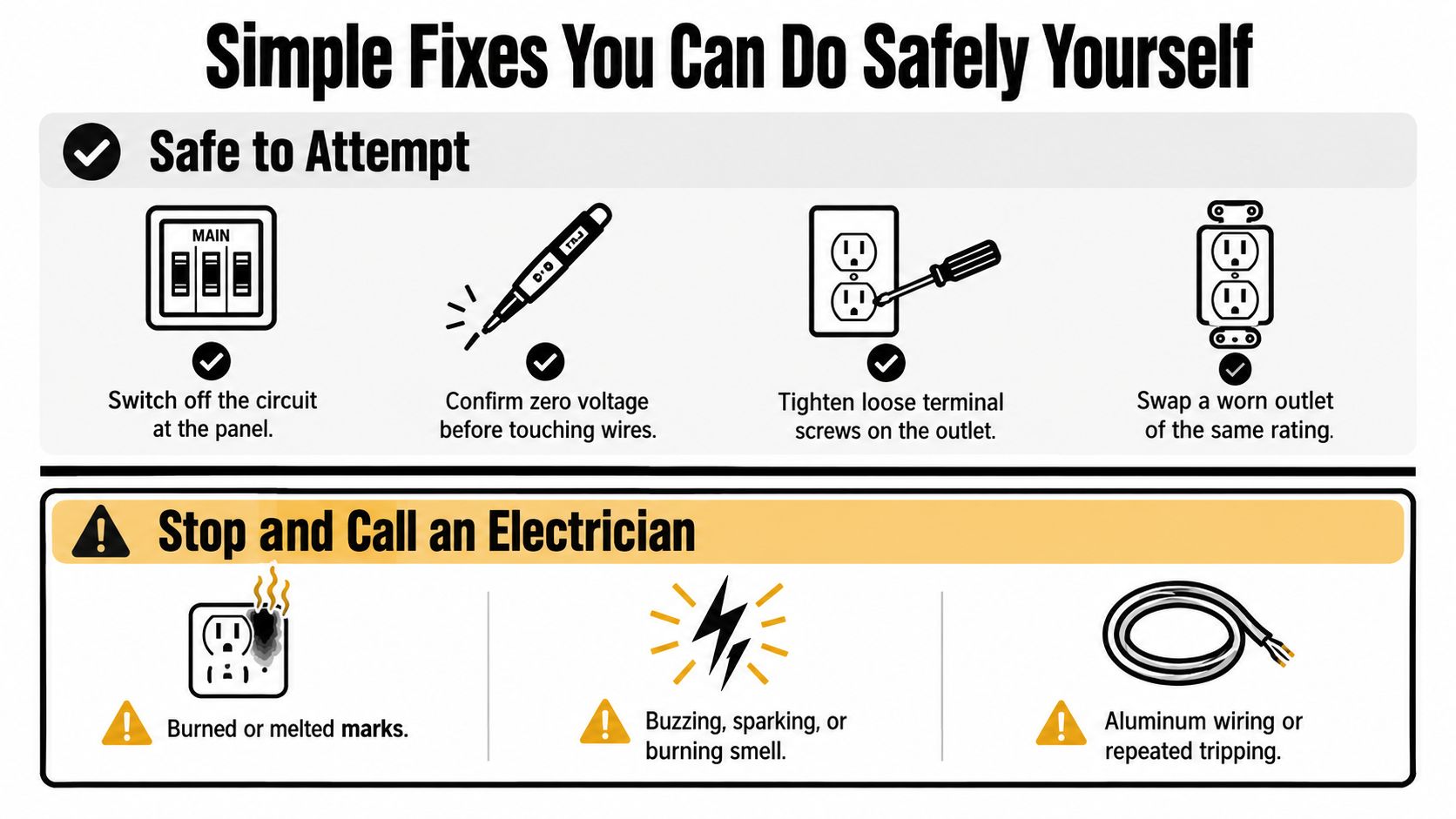
DIY repair starts only after the checks point to a straightforward standard receptacle problem and no warning signs are present. Turn off the correct breaker, verify that the outlet is dead with a suitable tester, use a flashlight, and keep the work area dry.
Don't work on aluminum wiring, multi-wire branch circuits, or anything inside the service panel. If you can't positively identify the circuit, stop before removing the faceplate.
A cautious receptacle replacement
A confident DIYer may replace a standard receptacle when the wiring is familiar, intact copper, and easy to identify. Match the new device's type and rating to the old one. For a typical receptacle:
Brass screw: Connect the hot conductor, usually the black wire.
Silver screw: Connect the neutral conductor, usually the white wire.
Green screw: Connect the bare or green grounding conductor.
Terminal method: Use the screw terminals correctly rather than casually moving wires into push-in holes.
Physical fit: Fold the conductors neatly, seat the receptacle flush, and tighten the yoke so the faceplate sits flat.
Take a clear photograph before disconnecting anything, then move one conductor at a time. Don't trust wire color alone in an altered installation. If the box contains more conductors than expected, a shared neutral, aluminum conductor, or damaged insulation, close it back up and call an electrician.
A scorched, cracked, melted, or loose receptacle should be replaced, not reused. A loose yoke that only shifts inside the wall may need careful tightening, but don't mistake a moving faceplate for a safe connection behind it.
After the repair, reinstall the faceplate, restore power, and test the outlet. If the breaker trips, the device remains dead, or power flickers, turn the circuit off again. For homeowners who prefer help with household repairs rather than electrical work, handyman services from 1st Choice Home Repairs are one local option, while electrical faults should remain with a qualified electrical professional.
Warning Signs and When to Call a Licensed Electrician
Stop troubleshooting immediately if the receptacle is hot, smells burned, buzzes, crackles, sparks when a plug goes in, or shows scorch marks or discoloration. A plug that falls out, a faceplate that feels warm, or power that comes and goes also deserves attention rather than repeated use.
Those symptoms can indicate a degraded terminal, arcing behind a loose yoke, a failing push-in connection, or damage inside the wall. First American's electrical problem guidance also identifies melted wires, scorch marks, loose receptacles, burning smells, and intermittent power as reasons to seek professional inspection.
Situations that are not DIY repairs
Call a licensed electrician when you find:
Burned or melted insulation: Heat may have traveled beyond the receptacle.
Water near the outlet: Moisture can create a ground-fault risk and may return after the surface dries.
Repeated GFCI or breaker trips: The protective device is responding to a fault that hasn't been resolved.
Aluminum branch wiring: The connection method and compatible devices require specialized judgment.
Double-tapped breakers: Multiple conductors under a terminal may violate the equipment's listing or signal an installation problem.
Federal Pacific or Zinsco equipment: Panel concerns require a professional evaluation, not a homeowner reset.
Any work inside the service panel: The panel can contain energized components even when a circuit is off.
For homeowners in St. Charles, O'Fallon, Lake St. Louis, Chesterfield, Wildwood, St. Peters, Ballwin, and nearby communities, a service visit should begin with a symptom review, a controlled power check, and inspection of the receptacle, upstream protection, and related wiring. Ask what failed, what must be repaired, and whether the quote covers only the receptacle or also the underlying circuit issue. Local repair providers may also offer upfront pricing and financing when the work grows beyond a single device.
You don't lose points as a homeowner by calling for help. You make the safer decision when the evidence points behind the wall, into the panel, or toward a fault that keeps returning. Electrical repair and installation services can address outlet problems while keeping the inspection focused on the actual cause.
If your outlet is still dead after testing the device, checking nearby GFCIs, and performing one careful breaker reset, 1st Choice Home Repairs can help with outlet-related repairs and broader home maintenance needs in the St. Charles area. Visit 1st Choice Home Repairs to request service, discuss the symptoms, and ask about available financing for repairs that extend beyond a single receptacle.
Comments