
Dishwasher Not Cleaning Dishes Properly: Fix It Fast

You open the dishwasher expecting clean plates, then find dried sauce on the bowls, cloudy glasses, and grit stuck to the silverware. The machine finished its cycle, but the dishes still need hand-washing. That usually doesn't mean the appliance is ready for replacement. Cleaning performance depends on several working together, including water delivery, temperature, mechanical action, detergent chemistry, loading, and drainage.
A filter rinse may solve one failure, but it won't correct a detergent tablet that never dissolves, a spray arm blocked by a pan handle, or water that's too cool to break down grease. Use the checks below in order. They'll help you separate a simple maintenance problem from a supply, circulation, or control issue that deserves professional attention.
Quick Diagnostic Checklist for Common Dishwasher Problems
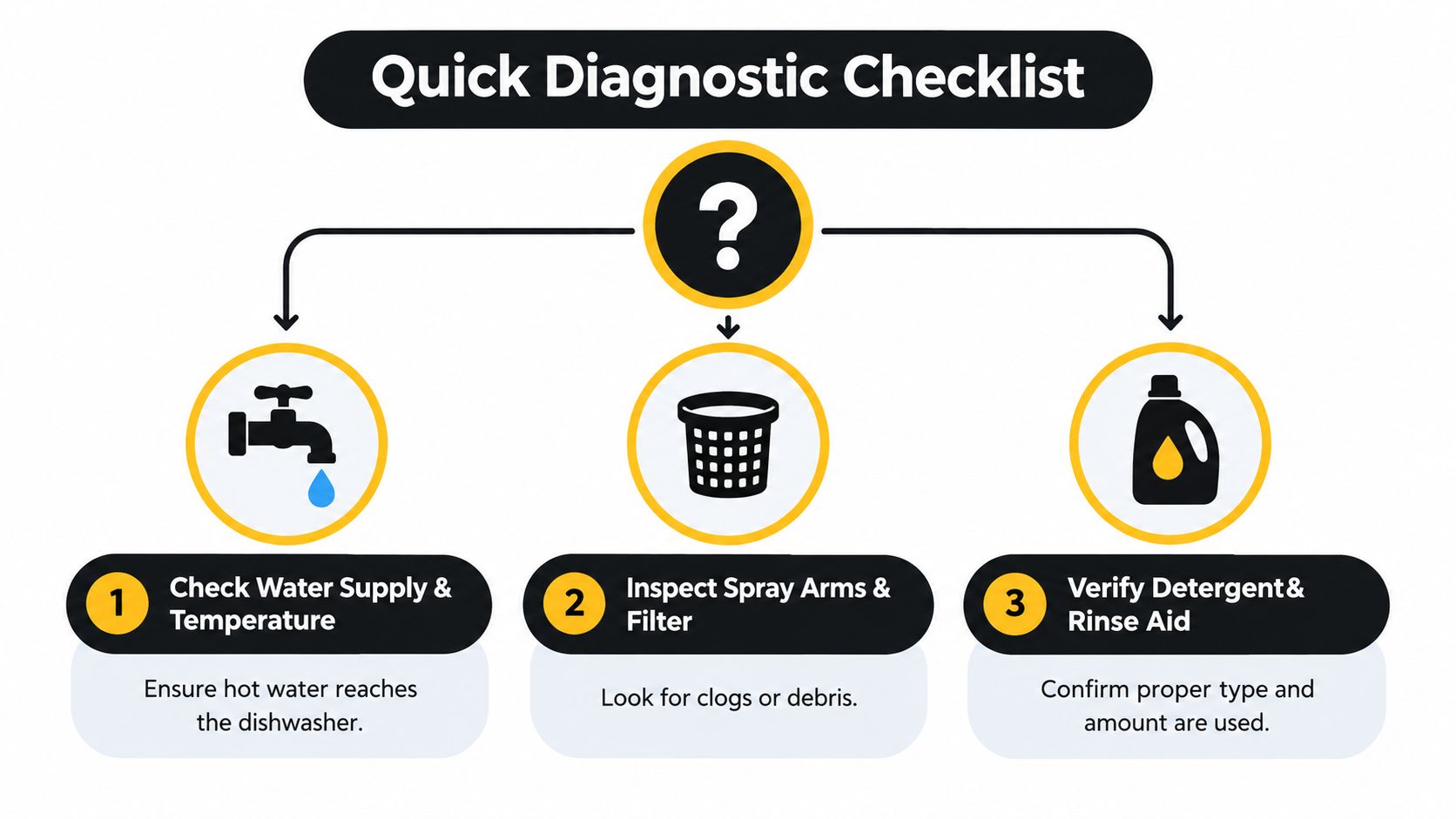
Start with the fastest checks before ordering parts. Open the door, pull out the lower rack, and look at the bottom of the tub. You're checking whether the dishwasher can bring in hot water, circulate it through clear passages, and remove dirty water afterward.
Start with water and movement
Check the hot-water supply. Run the kitchen faucet nearest the dishwasher until the water is hot, then test it with a kitchen thermometer. A practical target is about 120 degrees Fahrenheit, a temperature also identified in troubleshooting guidance from appliance repair specialists. If the water is clearly cool, the first fill may be too cold for effective grease removal. Don't raise the water heater blindly, because scalding water can injure someone. Check the appliance manual and use caution.
Inspect the filter. Remove the lower rack and follow the manual's instructions for removing the filter. Food sludge, glass fragments, paper labels, and mineral buildup can restrict the system or allow debris to recirculate. Rinse the filter under hot water and use a soft brush rather than a sharp tool that could damage the mesh.
Spin and inspect the spray arms. Turn each arm by hand. It should move freely without scraping the rack or hitting a tall pan. Look into the small jet openings for seeds, scale, or dried detergent. A blocked arm can leave one rack or one side of the load dirty while the rest appears acceptable.
Interpret what you find
If the filter is dirty and the arms are obstructed, clean those parts and run a normal cycle with correctly loaded dishes. If they're clean but the spray arms barely move, listen for weak humming, unusual grinding, or repeated filling and draining. Those symptoms point toward restricted water flow, a circulation problem, or an inlet component rather than ordinary maintenance.
The 2025 German household dishwasher study found that user behavior commonly undermined cleaning performance. In 26 households, only 74% of runs used the dishwasher at full capacity, about 50% of cycles had overlapping dishes, and roughly 30% of participants used a fully systematic loading pattern. The same study found 94% of respondents were satisfied or very satisfied with cleaning, showing why a machine can seem acceptable while still producing avoidable failures.
Practical rule: Diagnose water, circulation, and chemistry before assuming the control board has failed.
Spray Arms and Filters the Hardware Fixes That Matter
Spray arms and filters are common trouble spots, but “clean them” is incomplete advice. You need to check whether the parts are still capable of maintaining water pressure and directing it across the racks.
Cleaning the filter without damaging it
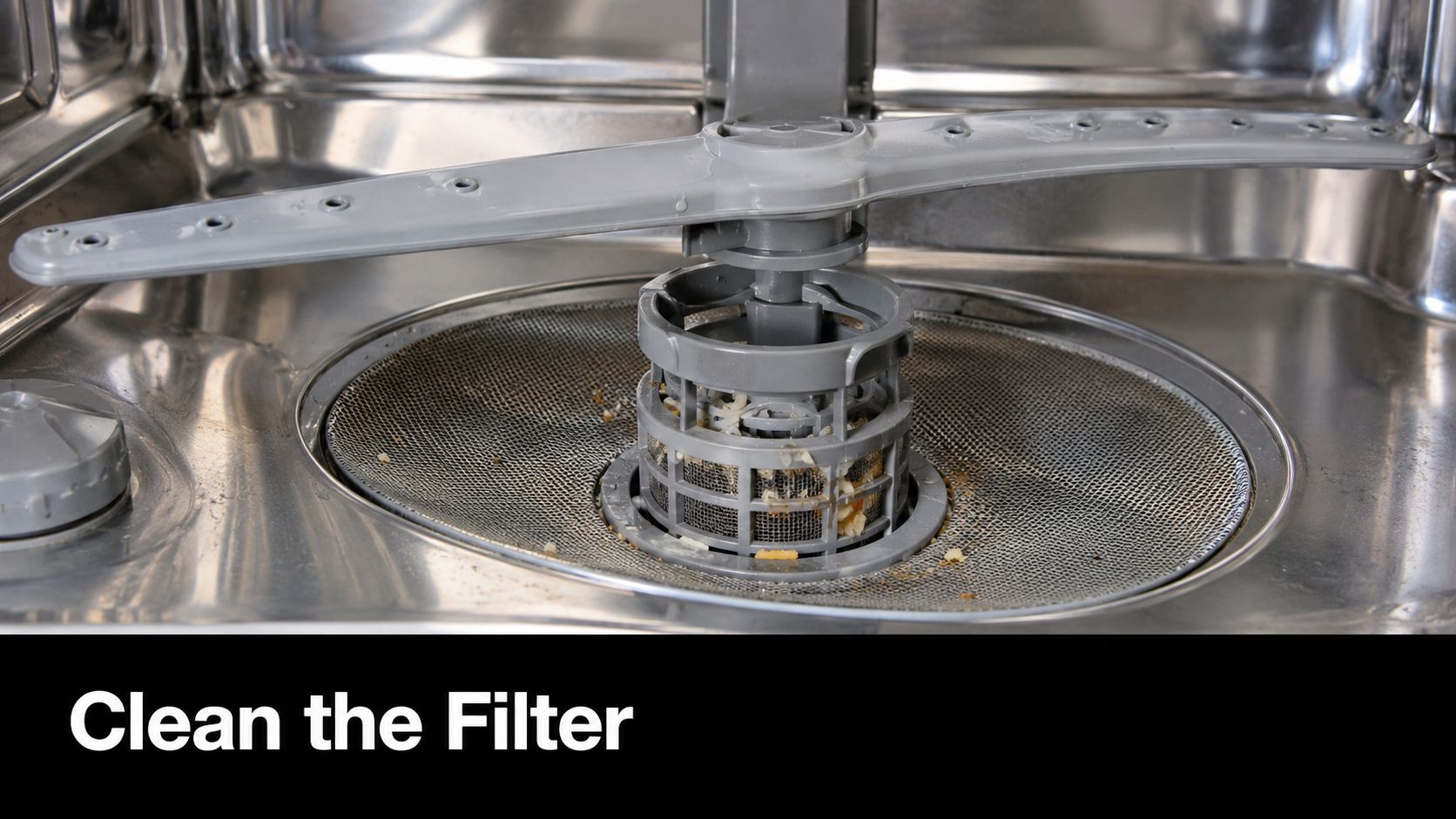
Switch off the dishwasher and remove the lower rack. Most removable filters sit below the rack, although the locking method varies by model. Twist or lift the filter as the manual specifies, then rinse it under warm running water.
Use a soft nylon brush on greasy film and trapped food. A wooden toothpick can help lift material from a narrow opening, but don't stab through fine mesh. Check the filter housing as well. A clean filter installed over debris can still restrict flow, and a filter that isn't locked in place may allow food particles to bypass it.
A filter basket is a replacement candidate if it's cracked, warped, missing its locking tabs, or no longer seals against its housing. A damaged filter doesn't just look untidy. It can let debris return to the wash system and may contribute to repeated grit on dishes.
Clearing and testing spray arms
Remove the lower arm only as described in the appliance manual. Some models release with a clip, while others use a retaining nut or a simple lift-off design. Rinse the arm, hold it toward a light, and clear each nozzle with a toothpick or small soft brush. Don't enlarge the holes with a drill or force a metal wire through them, because changing the openings can alter the spray pattern.
Reinstall the arm and rotate it by hand. Check for cracks along the seams, a loose hub, wobbling, or a worn bushing. A cracked plastic arm can leak pressure before water reaches the jets. A loose bearing can make the arm wobble instead of turning smoothly. If the arm is brittle, split, or visibly distorted, cleaning won't restore it. Replace the part with the exact model-compatible component.
Know when a cleaning attempt has failed
After reassembly, run a cycle and check the results on the rack most affected. If only the top rack remains dirty, focus on the upper arm, its feed connection, and tall items that may block its path. If every rack is poor despite clear arms and a clean filter, stop repeating the same cleaning routine and investigate water temperature, inlet flow, detergent release, or the circulation pump.
For broader home repair support, you can review kitchen repair services before deciding whether the dishwasher problem has moved beyond basic maintenance.
Water Temperature and Detergent Chemistry Secrets
A dishwasher can have spotless spray arms and still leave grease, film, or dried food if the water and detergent aren't working as a matched system. Temperature affects how quickly detergent activates and how easily fats loosen. Water hardness changes how minerals interact with that detergent, while loading determines whether the chemistry can reach the surface at all.
Test the supply at the sink closest to the machine. Run the hot tap until it reaches its normal peak, then measure it with a thermometer. If the water arrives lukewarm, check the water-heater setting and the dishwasher's heating behavior according to the manual. The U.S. Department of Energy found that cleaning performance became more variable and worse on average under heavy soil loads than under medium or light loads, and its testing identified at least 1.1 kilowatt-hours per cycle and 3.2 gallons per cycle as typical thresholds that reliably maintained adequate cleaning performance in tested products. See the Department of Energy dishwasher technical analysis for the testing context.
Match the detergent to the water
Don't use hand dish soap in the appliance. It creates excessive suds and can cause leaks or poor operation. Use a product labeled for automatic dishwashers, then compare the format with your household conditions.
Powder gives you dose control. It can be useful when you need to adjust the amount for a smaller load or different soil level.
Pods and tablets simplify dosing. They're convenient, but a fixed dose may be excessive for a lightly soiled load or insufficient for a heavily soiled one.
Concentrated and phosphate-free formulas need testing. Current detergent choices include plant-based ingredients, concentrated products, pods, and smart-dosing systems. Their results can change with water hardness, cycle selection, and load type, a point discussed in neutral-market detergent coverage.
Overdosing isn't a shortcut to cleaner dishes. Too much detergent can leave residue, especially when the cycle doesn't use enough water or when mineral-heavy water binds with the product. Underdosing can leave grease and food behind. Change one variable at a time, such as detergent format or cycle, so you can identify what helped.
Treat rinse aid as a performance tool
Rinse aid helps water sheet away from dishes instead of drying into spots. It won't fix a clogged arm or a failing pump, but it can improve drying and reduce mineral spotting when the machine's rinse system is functioning correctly. Bosch troubleshooting guidance lists detergent dissolution, program choice, water temperature, and rinse aid as distinct factors that can resemble a hardware failure. The same guidance is available in Bosch's dishwasher cleaning support.
If a tablet remains in the dispenser after the cycle, check whether a large plate or utensil blocked the dispenser door. A damp, compacted tablet can also indicate poor water delivery or a dispenser problem. Use the correct cycle for the soil, and avoid pre-rinsing every dish so the machine's sensors and detergent have enough soil to respond to.
Loading Techniques and Drainage Problems Frequently Missed
A dishwasher can run through a full cycle and still leave dirty plates when the rack blocks the water path. Bowls nested together, cutting boards placed in front of the spray arm, and utensils lying across one another create dead zones. The appliance may be working normally, while the load prevents water from reaching the dishes.
Leave space between plates instead of pressing them together. Angle bowls downward so water can enter and drain, and position cups with their interiors facing the spray pattern without allowing dirty water to pool. Keep tall pans and cutting boards away from the lower arm's sweep and the upper rack's water connection.
Run a practical before-and-after test. Load the dishwasher lightly, leave clear paths around each spray arm, and use the same cycle and detergent. If those dishes clean properly, the rack arrangement caused the problem. If the same areas remain dirty, return to spray-arm and water-flow checks rather than changing detergent repeatedly.
Drainage problems can ruin a good wash
Dirty water should leave the tub fully at the end of the cycle. Look for standing water in the filter well, sludge around the sump, and food buildup in the sink's air gap, if one is installed. When the dishwasher drains through a garbage disposal, its connection must be open and clear. A recently installed disposal may also still have its drain knockout in place, blocking discharge.
Inspect the drain hose beneath the sink. It should not be kinked, crushed, or sagging in a way that lets wastewater flow back toward the dishwasher. Run a short cycle, cancel it according to the manual, and watch whether water exits forcefully into the drain. Keep your hands out of the sump while the appliance is connected to power.
If the pump hums but water barely moves, the drain path may be blocked or the pump may be failing. Repeated humming, a burning smell, water returning after the cycle, or persistent standing water mean DIY work should stop. These symptoms can involve the pump or internal drainage components, where testing and access carry more risk than clearing a hose or correcting a load.
You can also review this dishwasher loading demonstration to compare rack placement and spray clearance.
When to Attempt DIY Repair Versus Calling a Pro
DIY makes sense when the task is visible, reversible, and limited to removable parts. Filter cleaning, spray-arm inspection, clearing a detergent cup, checking the drain hose, and correcting the load don't require you to open the electrical cabinet. Turn off the appliance before removing components, keep water away from electrical connections, and follow the model manual rather than relying on a generic diagram.
The decision changes when the symptom points inside the machine. A circulation pump, inlet valve, heating circuit, float switch, wiring harness, or control board can fail in ways that look similar from the rack. Testing those parts often requires access behind panels, electrical measurements, or disconnection of plumbing.
Use the risk-reward test
Ask three questions before ordering a part:
Can you identify the failed component? A dirty spray arm is visible. A weak circulation pump isn't confirmed by a guess.
Can you work safely? Shut off the breaker before accessing electrical parts, and close the water supply before disturbing a hose.
Will the repair remain economical? A low-cost cleaning fix may be worthwhile. Several unconfirmed parts can turn a modest repair into wasted money and time.
A professional diagnosis also reduces the chance of replacing a good component because it was the easiest part to reach. In the St. Charles and O'Fallon area, the fair comparison isn't just a repair invoice versus a replacement part. It's the invoice versus multiple incorrect parts, return shipping, lost weekends, and the possibility of creating a leak or electrical hazard.
Stop immediately for these symptoms
Don't continue experimenting if the dishwasher leaks from underneath, trips the breaker, smells hot or electrical, fills and drains abnormally, or leaves standing water after you've confirmed the hose and disposal connection are clear. A pump that hums without producing circulation, a valve that doesn't admit water, and a control that ignores commands all justify professional testing.
For jobs that involve broader household repairs, handyman services may also be relevant, but dishwasher electrical and water faults should be handled by a qualified appliance technician familiar with the specific model.
A safe boundary: If the repair requires live-voltage testing or you can't explain which failed part caused the symptom, stop replacing parts and schedule diagnosis.
Local Expert Repair and Financing Options Available to You
After the basic checks, give the technician a precise symptom report. Describe whether the top or bottom rack cleans poorly, whether the dispenser opens, whether water remains in the tub, whether the machine heats, and whether the problem started after a detergent or plumbing change. These details help separate loading habits and water chemistry from a failed component.
A qualified technician should examine the water supply, filter housing, spray-arm movement, drain path, dispenser, inlet system, circulation system, and related controls. Before approving work, ask what failed, how the diagnosis was confirmed, whether the replacement is model-specific, and what the quoted price includes.
Compare the practical options
Situation | Sensible next step |
|---|---|
Debris in the filter or spray-arm jets | Clean and retest at home |
Poor results after loading and detergent corrections | Arrange a diagnostic visit |
Electrical smell, leak, or breaker trip | Stop using the dishwasher and request service |
Several uncertain parts appear suspect | Get diagnosis before ordering components |
Repair fits the appliance's condition and household needs | Compare repair with replacement value |
1st Choice Home Repairs serves St. Charles, O'Fallon, Lake St. Louis, Chesterfield, Wildwood, St. Peters, Ballwin, and nearby communities. The company handles dishwasher and other appliance repairs, with 25 years of hands-on experience stated by the business. Upfront pricing can clarify the proposed work before service begins.
A local technician can also identify interactions that a filter cleaning will not resolve, such as hard-water residue, detergent performance, restricted circulation, or a plumbing fault. That diagnosis is useful when the dishwasher appears mechanically clean but still leaves the same dishes dirty.
Financing may help when a dishwasher fails alongside another household expense. Review the available financing options, then ask which services qualify, what payment terms apply, and whether approval is required before scheduling. Clear answers let you compare a safe repair with continued trial and error.
Final Steps to Keep Your Dishwasher Cleaning Like New
A dishwasher stays dependable when small restrictions are found before they become circulation problems. Set a recurring monthly reminder to remove the filter, rinse it, inspect the sump, and check the spray arms for blocked jets. Wipe the detergent cup and dispenser seal, then look under the sink for a kinked drain hose or signs of a slow leak.
Use a short performance check after maintenance. Load a few normally soiled dishes with open spray paths, select the appropriate cycle, and confirm that the dispenser opens, the arms move, the water heats, and the tub drains. If the same rack area remains dirty after the load has been corrected, record that detail rather than changing several components at once.
Adjust the routine when conditions change
A new detergent can behave differently from the previous product, particularly in hard-water conditions. When changing brands or formats, keep the load style and cycle consistent while you evaluate the result. Use rinse aid when spotting or poor sheeting is the issue, but don't treat it as a substitute for clear spray paths, adequate temperature, or proper drainage.
Use this decision flow:
Dirty filter or blocked jets: Clean the parts and retest.
Poor result with clear hardware: Check temperature, detergent release, rinse aid, and loading.
Standing water or weak circulation: Inspect the drain path, then stop if the pump or inlet system appears faulty.
Electrical, leak, or control symptoms: Leave the appliance off and call a professional.
A written record of symptoms, cycle choice, detergent format, and recent changes helps a technician work faster. For homeowners in St. Charles, O'Fallon, Lake St. Louis, Chesterfield, Wildwood, St. Peters, Ballwin, and surrounding communities, professional help is appropriate when the dishwasher still isn't cleaning after these checks or when safety is uncertain.
1st Choice Home Repairs can diagnose dishwasher cleaning problems involving poor cycles, standing water, supply issues, and related appliance faults, with service available across the local communities listed above. If your dishwasher still leaves food, film, or water after you've checked loading, filtration, temperature, and drainage, visit 1st Choice Home Repairs to request service and review available financing options.
Comments